Rising rents, limited supply, and the expiration of long-term affordability protections threaten to displace millions of families across the country. At the same time, affordable housing providers and developers are struggling to access the capital required to increase production and preservation. Taken together, these pressures reveal a system stretched far too thin.
Meanwhile, donor-advised funds (DAFs) have seen meteoric growth over the last fifteen years. In 2010, only a few hundred thousand accounts existed; as of 2024, there were roughly 2.56 million, according to the DAF Research Collaborative. Generally managed by public charities, these giving accounts allow donors to make contributions, receive an immediate tax deduction, and recommend grants or investments over time. With more than $326 billion in collective assets, DAFs represent one of the most powerful — yet still underutilized — sources of impact capital available today.
“The housing crisis and DAF growth are major trends we see converging,” said Amanda Walz, senior director of resource development at Enterprise Community Partners, where she collaborates with philanthropic donors to support impact-driven grantmaking. “By bringing these forces together, we have a rare opportunity to create a more efficient and sustainable system for affordable housing financing.”
Traditionally, DAFs have been used for straightforward charitable giving that funds the essential work of nonprofits. Increasingly, however, donors are looking to complement their grantmaking with mission-aligned investments that extend their impact over time. By using DAFs to invest as well as give, donors can spark larger flows of capital, bring proven solutions to scale, and advance the creation and preservation of affordable housing.
Why Affordable Housing Is Ideal for DAFs

Every affordable housing project depends on what’s known as a capital stack: a mix of public subsidies, tax credits, loans, grants, recoverable grants, and private investment that must be carefully aligned for each project to move forward. (To learn more, download our guide to affordable housing.)
“DAFs fit naturally into that structure,” said Rob Bachmann, director of capital originations for Enterprise’s real estate equity group. “They offer enormous flexibility — they can provide catalytic philanthropic and investment capital that may serve to spur additional investment, or generally help strengthen the overall stack to make projects work or even test new models.”
DAF dollars are particularly valuable for early-stage expenses that traditional financing can’t or won’t cover. Catalytic investments may accept disproportionate risk or lower returns compared to conventional investments in order to both achieve positive social outcomes and, importantly, spur additional investment from capital sources who may not otherwise get involved, Bachmann explained. A grant, meanwhile, might fund a new community-based organization’s capacity-building work.
The ability to deploy both grant and investment dollars makes DAFs an ideal fit for affordable housing, where timing is everything.
“It’s about meeting the right financial needs at the right time,” said Anna Smukowski, managing director of impact investing at Enterprise. “When DAF dollars are used strategically, they bring the public, private, and philanthropic sectors together to get projects from concept to completion.”
Philanthropy as the Foundation
For many DAF holders, high-impact giving remains a crucial part of their social impact objectives.
“Traditional grants are essential to a donor’s holistic social change strategy and legacy building,” said Jessica O’Hare, director of major gifts at Enterprise. “We’re excited about the expanding options for impact that donors increasingly have at their disposal.”
According to O’Hare, some donors are motivated by place — they want to see a visible difference in their own communities. Place-based grants can strengthen local housing nonprofits, leadership programs, and neighborhood initiatives. In Detroit, for example, DAF-funded grants helped expand the Community Development Organization Fund, which strengthens grassroots housing organizations and has generated $200 million in economic impact for the area.
Others are motivated by themes that intersect with housing, like workforce development or health equity. Through Enterprise’s Faith-Based Development Initiative, DAF-funded grants have helped houses of worship transform underused land into community assets like affordable housing, childcare centers, and health clinics since its launch in 2006. To date, the program has created more than 1,900 homes, with another 9,000 in development.
“We’ve seen donors recommend that DAF sponsors test innovative ideas and respond to immediate times of crisis, like the recent Los Angeles fires,” said Walz. “Those philanthropic dollars often spark partnerships and programs that wouldn’t have been possible otherwise — and that kind of catalytic giving can make way for larger, longer-term investment.”
From Giving to Investing
As donors grow more engaged, many are looking to move beyond giving alone to explore how their DAF dollars can be used to fuel systemic change. Catalytic investments make that possible. Unlike grants, DAF investments can be structured to target certain return objectives and risk tolerance for the DAF, allowing dollars to be recycled and redeployed over time.
Community development financial institutions are a natural home for this kind of flexible, mission-driven capital, as evidenced by Opportunity Finance Network’s new brief demonstrating strong alignment between DAFs and community development finance. DAFs have provided capital to Enterprise Community Loan Fund to finance affordable housing, schools, commercial space, and other critical community assets.
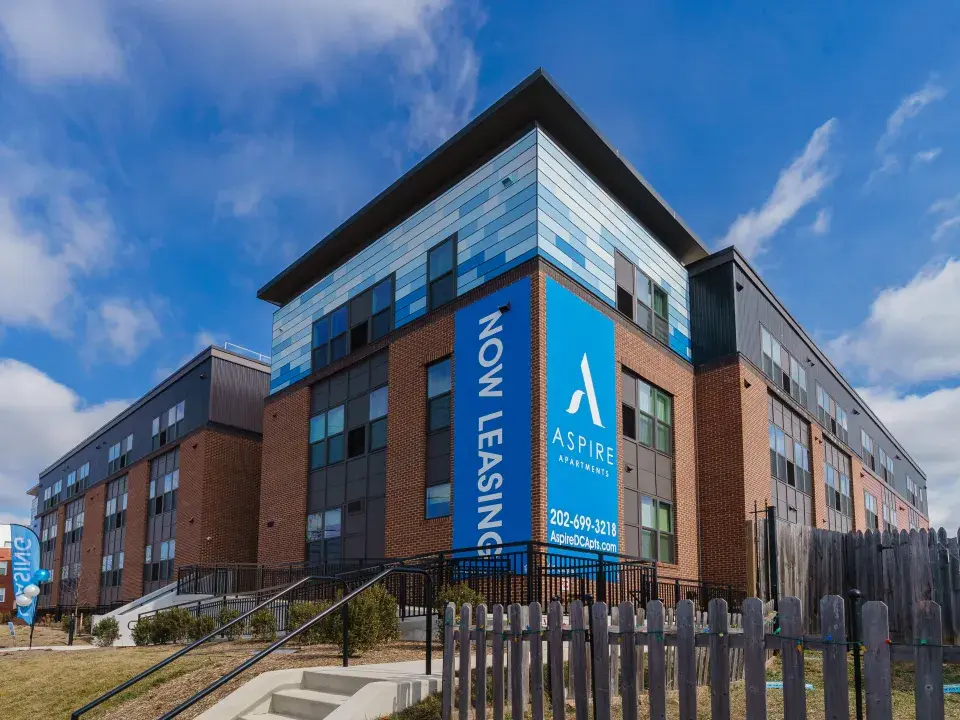
That model has proven successful in partnership with the Greater Washington Community Foundation, who have teamed up with Enterprise Community Loan Fund to leverage donor investments into more than $40 million in financing for affordable housing projects across the DC region.
Another example is the Renter Wealth Creation Fund, which finances affordable housing and offers residents monthly cash back for on-time rent payments and the potential to share in the appreciation of their property if it’s sold or refinanced for a profit — helping renters build wealth through housing, an avenue traditionally limited to homeowners. A DAF investment helped scale the effort and attract additional investors by providing early, subordinate capital.
“The case of the Renter Wealth Creation Fund shows how DAFs can act as flexible capital to test new ideas,” said Bachmann. “By taking on that early risk to support a new model, those dollars helped prove the concept, making it easier for other investors to come in and scale the model and impact.” It's important to note that any investment in a real estate direct participation program like Renter Wealth Creation Fund that's sold through a private placement offering bears risk, he added, including general economic and operational risks inherent to the ownership of real estate, a lack of investment liquidity, or the potential for loss of principal.
This blending of philanthropic grants and investment capital points to a new way forward — one that treats impact not as a single act of giving, but as an ongoing cycle of reinvestment in communities.
“Continued DAF participation in affordable housing could be a game changer,” said Walz. “When we view grants, investments, and public funding as parts of the same system, we can deploy resources more effectively and better meet the urgent needs of communities across the country.”
Donor-advised funds are powerful tools in impact investing. Join our webinar on July 16 to learn how DAFs can be used to support affordable housing and community development.
Risk Disclosure:
This communication is for informational purposes only and does not constitute an offer to sell, a solicitation of an offer to buy, or a recommendation regarding any security. Any such offer or solicitation may be made only by means of a private placement memorandum, prospectus, or other offering documents prepared and distributed in compliance with applicable securities laws.
The Renter Wealth Creation Fund (“The Fund”) is sponsored by Enterprise Community Investment, Inc. (“ECI”), the investment arm of the Enterprise family of companies, and offered and sold through its affiliated broker-dealer, Enterprise Equities, Inc. (“EEI”). The fund is an unregistered security sold through private placements in direct participation programs to qualified investors, and is subject to risk of loss, including a total loss of principal. The fund is closed and no longer offered to investors.
EEI is a broker-dealer registered with the U.S. Securities and Exchange Commission (“SEC”), a member of the Financial Industry Regulatory Authority (“FINRA”) and a member of the Securities Investor Protection Corporation (“SIPC”). For additional information on EEI, visit FINRA at www.finra.org and to learn more about SIPC, visit www.sipc.org.