Eighty-six percent of community and economic development organizations consider climate issues mission-critical, according to a national Urban Institute survey. Yet just half report actively engaging in climate-related work.
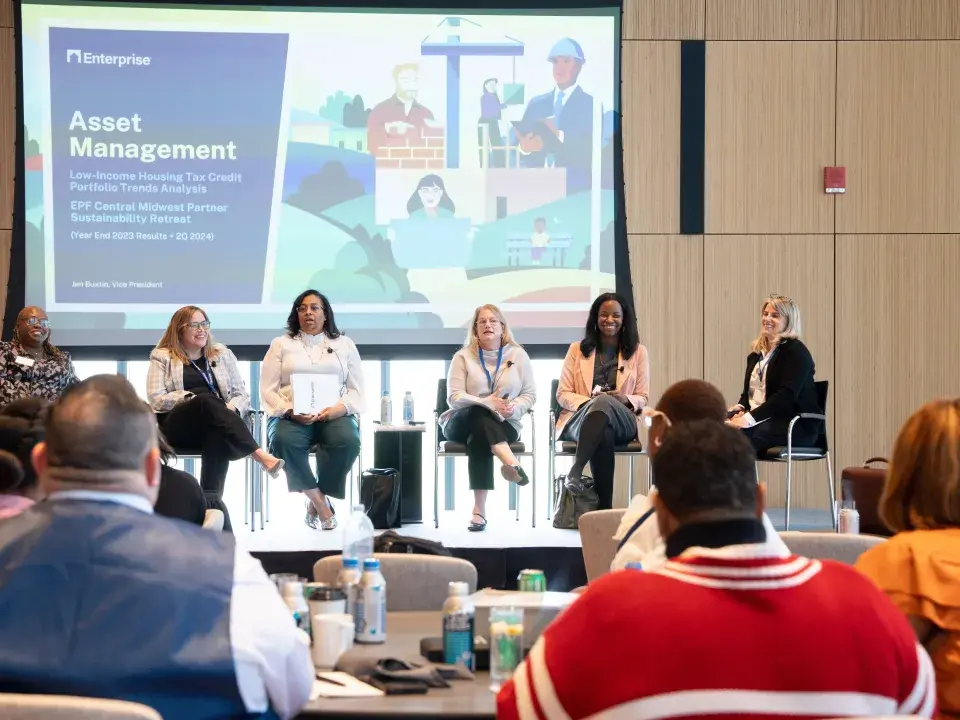
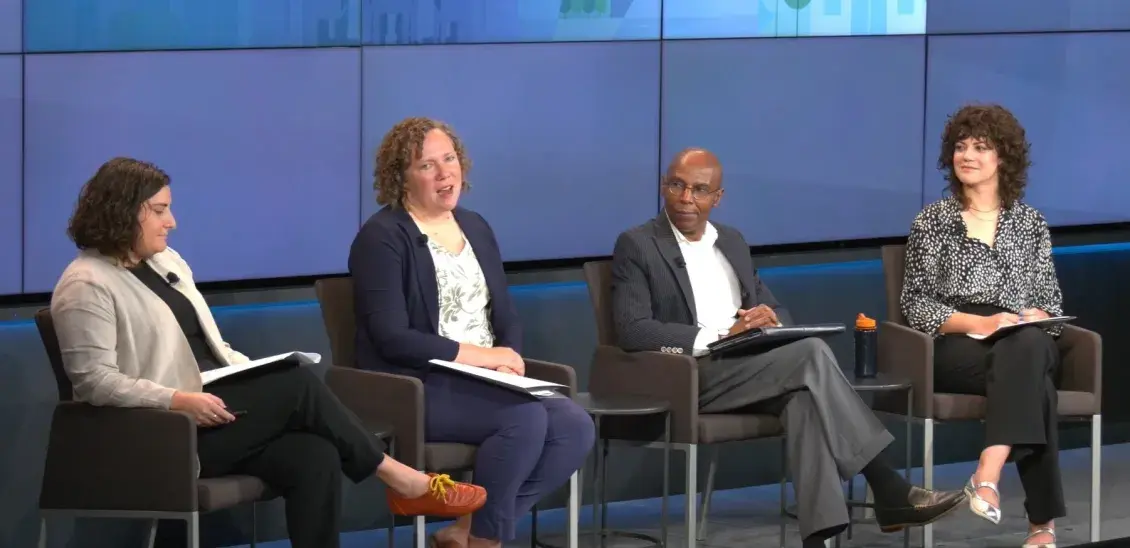
To translate the findings into practical strategies, the Urban Institute recently convened nationwide stakeholders, including Enterprise Community Partners Vice President of Building Resilient Futures Krista Egger. She joined Stuart Clarke of Hive Fund for Climate and Gender Justice and Madeleine Chaisson of Jobs for the Future on the panel, Opportunities and Challenges at the Community and Economic Development and Climate Nexus. Sara McTarnaghan of the Urban Institute moderated.
The panel’s central takeaway was clear: organizations need more support, resources, and practical pathways to deepen their engagement in climate-related issues.
Three Climate Insights
Egger stressed that organizations can integrate climate considerations into how they plan, build, and invest to create healthy, resilient, and affordable communities.
Here are three insights from her conversation with fellow panelists.
Embed climate into the mission
Tackling climate-related issues becomes more feasible when organizations see how it directly supports their core mission rather than competing with it. Organizations should integrate climate-related best practices, rather than treating them as an add-on, she said.For example, housing developers and organizations are better equipped to provide healthy, stable homes and strengthen long-term financial performance when planning and operations address climate risks. Access to accurate climate projections and practical knowledge allows housing providers to make smarter decisions about site selection, flood mitigation, building systems, energy efficiency, and resident safety.
Drawing on early lessons from Enterprise Green Communities, the national green building standard for affordable housing, Egger recalled how "green" operations manuals and resident engagement strategies were often relegated to appendices rather than integrated into day-to-day practice.
Her advice: don't "other" climate. When climate considerations are embedded in existing housing, operations, and asset-management decisions, they become standard practice rather than an added burden, said Egger.
Align investments with existing priorities
Urban Institute’s survey found that among organizations not currently engaged in climate work, 81% cited cost concerns and 72% noted limited resources or capacity.Egger acknowledged that these challenges can be particularly acute in the affordable sector, where financing timelines often misalign with the long-term payback periods associated with energy efficiency, electrification, and resilience investments.
Despite high capital demands, she urged the audience to “reject the idea that affordability and climate are a tradeoff.” Housing organizations are increasingly finding creative ways to advance climate goals in a resource-constrained environment, including partnering with lenders that understand the value of green housing investments.
Playing a growing role, green banks and mission-driven Community Development Financial Institutions (CDFIs) are developing underwriting approaches better suited to the long-term returns and benefits of climate-focused investments.
Sequencing improvements over time is another strategy. “Phasing climate work versus prioritizing immediate investments can be a potential path,” Egger said.
Rather than pursuing large-scale retrofits all at once, many housing providers are incorporating climate upgrades into long-term capital plans. Emerging tools like zero-over-time planning frameworks can help organizations map these decisions and align climate goals with existing property improvement schedules.
Egger encouraged the audience to seek opportunities to "multisolve." If a building needs a new heating system, why not install a heat pump that delivers both heating and cooling? If major building systems are nearing the end of their useful life, use scheduled replacements to evaluate electrification.
Bring community expertise to the table
Many community and economic development organizations participate in climate work but remain on the periphery of climate agenda-setting, funding decisions, and program design, according to the study’s findings.Egger underscored the sector’s unique ability to inform climate planning, investment, and policy decisions with firsthand knowledge of community conditions, priorities, and aspirations. Few organizations understand the realities facing residents, neighborhoods, and affordable housing providers better than community and economic development leaders.
And while shifting political priorities and funding conditions can create uncertainty, adaptability is second nature to community and economic development organizations that are accustomed to navigating complex challenges.
From Input to Impact
Momentum is possible when climate investments are framed around measurable benefits for people, communities, and local economies. With a seat at the table, community and economic development organizations can help shape investments that are practical, equitable, and responsive to community perspectives from the outset.
Nena Burgess is an intern on Enterprise's Building Resilient Futures team. View the Urban Institute event recording and explore their survey, How Community and Economic Development Organizations Engage with Climate Change.