Affordable housing has always been multidimensional by necessity. Yet in a world of surging energy costs, worsening climate risks, and deepening affordability pressures, families need housing to do more – to support health, resilience, and energy efficiency. Two decades of proof show that it can.
That proof comes at a pivotal moment for the housing field. With rare bipartisan support in the Senate and House for the Road to Housing bill, the sector has an opportunity not just to expand the housing supply, but to ensure housing delivers long-term affordability, stability, and performance.
“The question in front of us isn’t whether building smart and sustainably works — it’s whether we can move fast enough to make it the floor and not the ceiling,” said Enterprise CEO Shaun Donovan. “It can be hard to be an optimist these days, but I am one of them because I've seen what's possible when you have the right model and the will to scale it.”
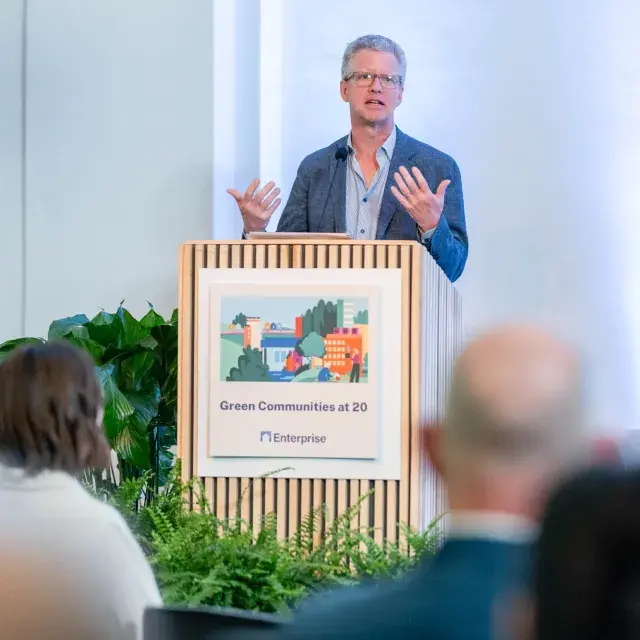
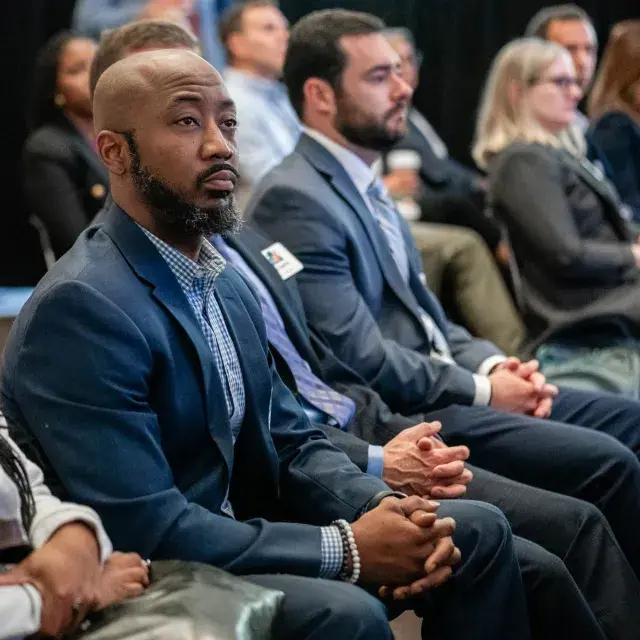
Donovan’s keynote remarks set the tone for a convening earlier this month marking the 20th anniversary of Enterprise Green Communities, the only national green building standard created with and for the affordable housing sector. Leaders from across the field filled the auditorium at the National Building Museum and joined via livestream to celebrate two decades of building green — affordably — and to examine what it will take to scale proven solutions in a moment of extraordinary urgency.
What Enterprise set out to prove two decades ago — that affordable housing could be green and sustainable — has been borne out in policy, practice, and lived experience.
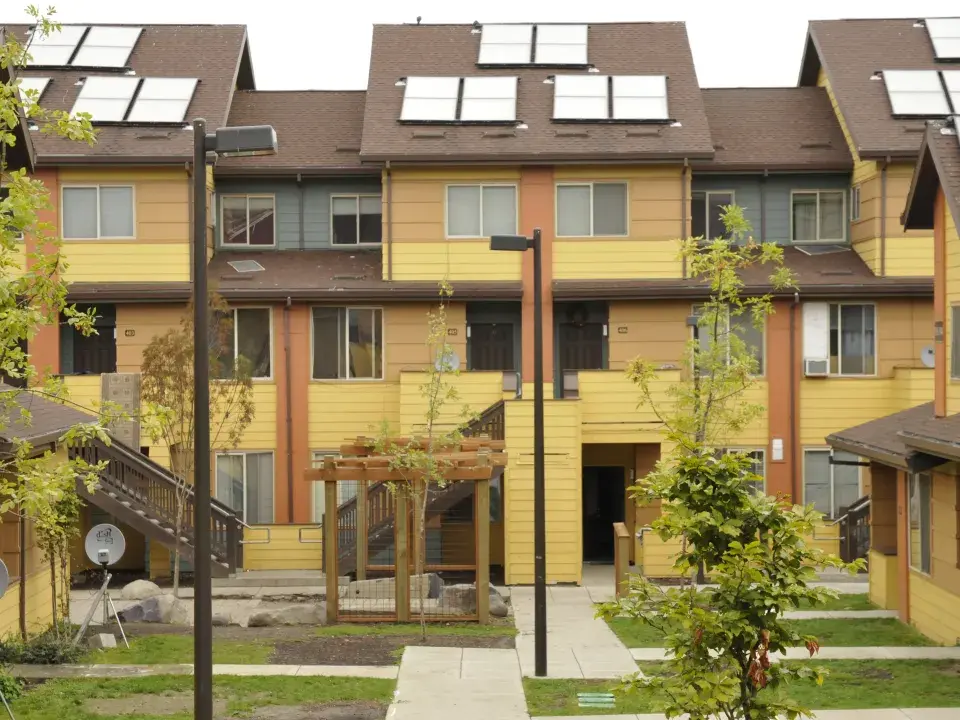
Today, Green Communities has certified more than 240,000 homes in 44 states, serving over 600,000 people nationwide. The standard has driven over $330 million in cumulative energy and water savings for families and building owners and prevented 4.2 million tons of carbon emissions. In 29 states and Washington, D.C., Green Communities is now required or incentivized through the Low-Income Housing Tax Credit.
Still, the anniversary event was not framed as a victory lap. Instead, it served as a pivot point: a moment to assess how far the field has come — and how it can and must move forward.
A Standard Built Through Collaboration, Not Trade-Offs
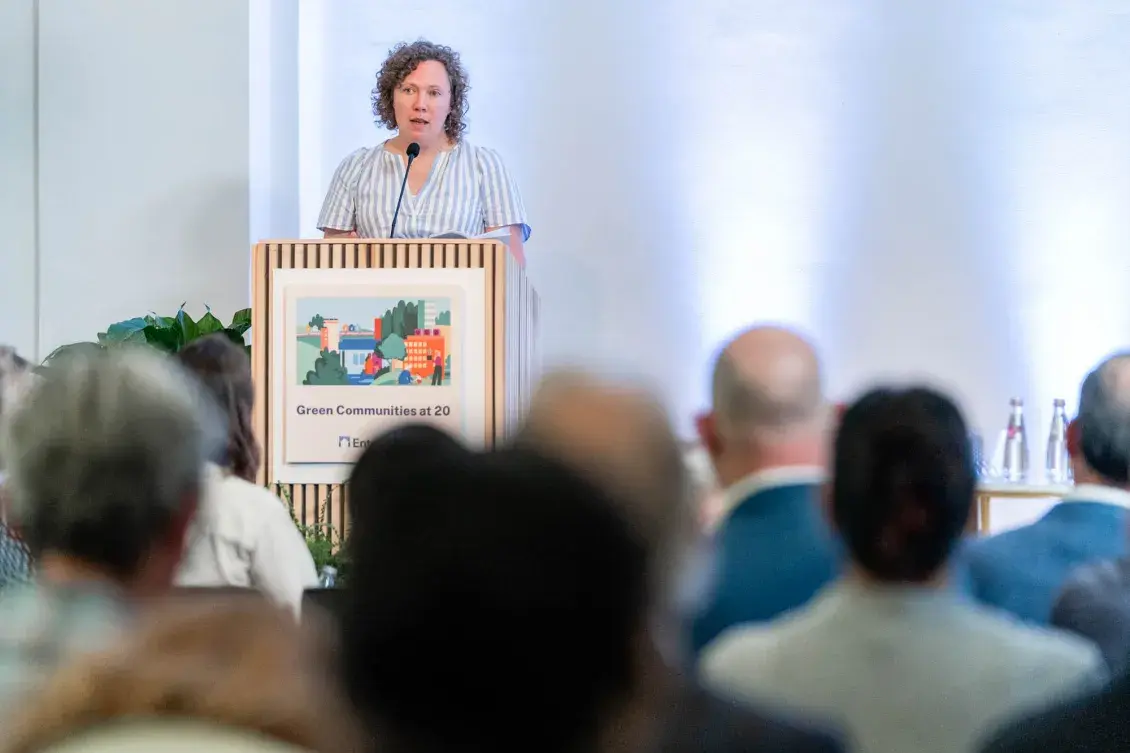
Krista Egger, Enterprise vice president of Building Resilient Futures, grounded the milestone in both reflection and resolve. When Green Communities launched, green building was largely considered incompatible with affordability.
“In the early 2000s, there were no roadmaps, no national standards, and few examples,” Egger said. “The prevailing assumption was that affordable housing required trade-offs — that you could focus on cost or sustainability, but not both.”
Enterprise challenged that assumption, bringing together developers, owners, engineers, building scientists, residents, and policymakers to answer a practical question: How do we make green building work for affordable housing, not as an aspiration or demonstration project, but as something financially feasible and scalable?
The answer became the Enterprise Green Communities Criteria, first released in 2005. Over time, the program scaled not through mandate, but through proof and partnership — piloting the criteria with early adopters, learning from real-word implementation, refining the standard based on cost and performance data, supporting adoption through training and technical assistance, and making Green Communities part of the national fabric of affordable housing through state and local policy.
Earlier this year, Enterprise published the 2026 Criteria, the latest edition of Green Communities. Organized around three interconnected themes — health, energy, and resilience — the updated criteria reflect both two decades of learning and the realities shaping affordable housing today.
Those themes provided the framework for the day’s panel discussions with experts and practitioners who have helped develop, apply, and advance Green Communities across the country.
Health: Housing as a Platform for Wellbeing
The first panel focused on moving beyond basic safety to explore how housing can actively support wellbeing, stability, and dignity. Moderated by Mary Ayala, director of Enterprise’s health and housing programs, the conversation brought together clinical, research, and practitioner perspectives.
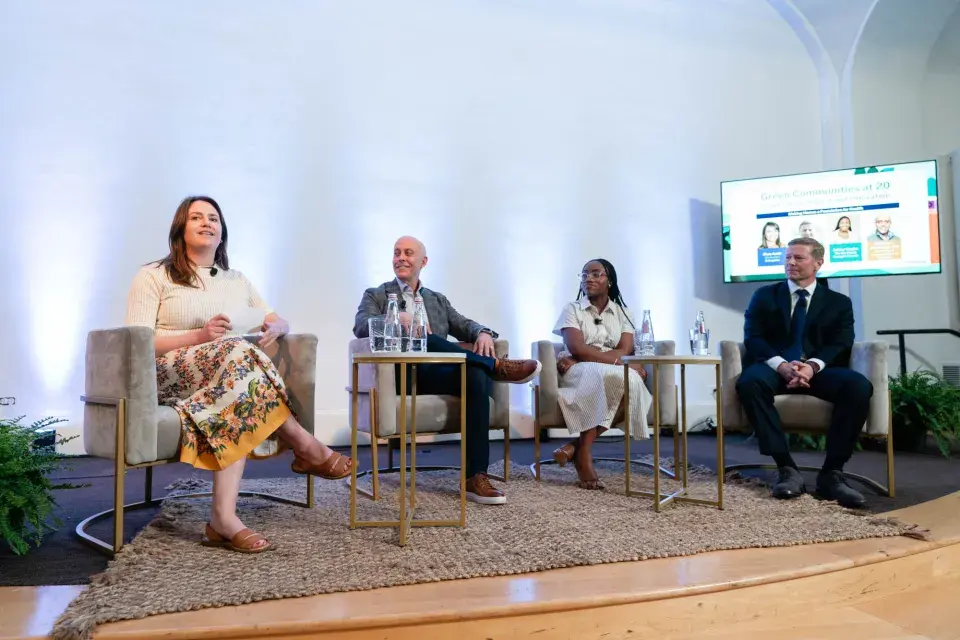
Matthew Trowbridge, a physician and public health researcher, reflected on the long arc of evidence linking housing conditions to health outcomes — and the importance of translating that evidence into standard practice.
“Health is no longer an add-on,” Trowbridge said, noting how Green Communities provides a flexible roadmap for raising the bar while remaining grounded in how affordable housing is actually built and operated.
That point was powerfully illustrated by Ashley Viagbo of The Arc of Prince George’s County, who described how Enterprise’s Health Action Plan reshaped renovations in group homes serving people with intellectual and developmental disabilities. Rather than treating upgrades as isolated technical fixes, the organization centered resident experience — rethinking materials, design elements, layout, and spaces for connection.
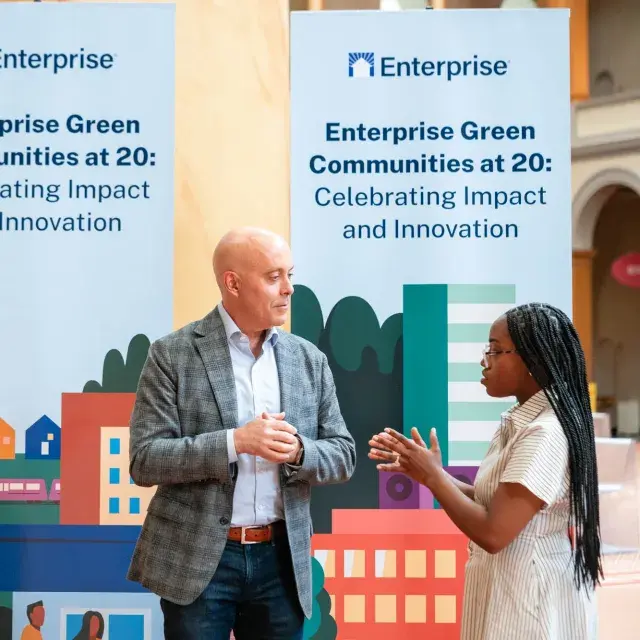
Viagbo shared the story of Oscar, an older resident who was afraid to return home after multiple falls. Through resident-informed design and targeted modifications, Oscar was able to return safely and avoid institutionalization.
“This wasn’t just another remodel,” Viagbo said. “It affected someone’s outcome and allowed them to live in a place where they could truly thrive.”
Jason Hartke of the International WELL Building Institute reinforced the panel’s central takeaway: quality affordable housing must integrate essential priorities without trade-offs.
“Every public dollar,” said Hartke, should require health, resilience, and sustainability as a foundation. “That’s the opportunity.”
Energy: Long-Term Affordability in a Volatile Landscape
A conversation on energy explored how the 2026 Green Communities Criteria respond to rising utility costs, advancing building technologies, and the need for long-term planning.

Moderated by Jackie Montesdeoca, senior director of clean energy at Enterprise Community Development, panelists emphasized how the updated standards strengthen expectations around energy performance, electric-ready design, and “zero over time” pathways to achieve net-zero emissions — while offering flexible certification tiers that meet projects where they are.
Andrea Foss of Steven Winter Associates urged an ambitious and achievable approach, explaining how proven systems, careful installation, and right-sized design often deliver better outcomes than untested technologies.
“You don’t have to be on the ‘bleeding edge’ to be green,” Foss said, stressing the importance of quality installations and third-party verification.
Damola Ademiluyi, who leads clean-energy initiatives for Enterprise Community Development, echoed that pragmatism. Ademiluyi described how energy management, building controls, and battery storage can yield double-digit energy reductions when paired with effective operations.
Training the green workforce is the next frontier, both panelists agreed. “All the mechanical systems are basically super computers now,” said Ademiluyi. “The technology is growing so fast and training within our teams is going to be a big part of that.”
Looking ahead, Foss underscored the importance of indoor air quality, noting that effective ventilation is foundational to both energy efficiency and resident health.
For Ademiluyi, data will be key to guiding future investments. “I’m excited to leverage data and technology as we move toward a more just, clean-energy future,” he said.
Resilience: Preparing Homes for What We Know Is Coming
The final discussion focused on resilience, examining the intersection of climate risk, insurance markets, and housing preservation and supply. Moderated by Michelle Dusseau Diller, associate director of policy for Enterprise’s Building Resilient Futures team, the conversation highlighted both risk and readiness.
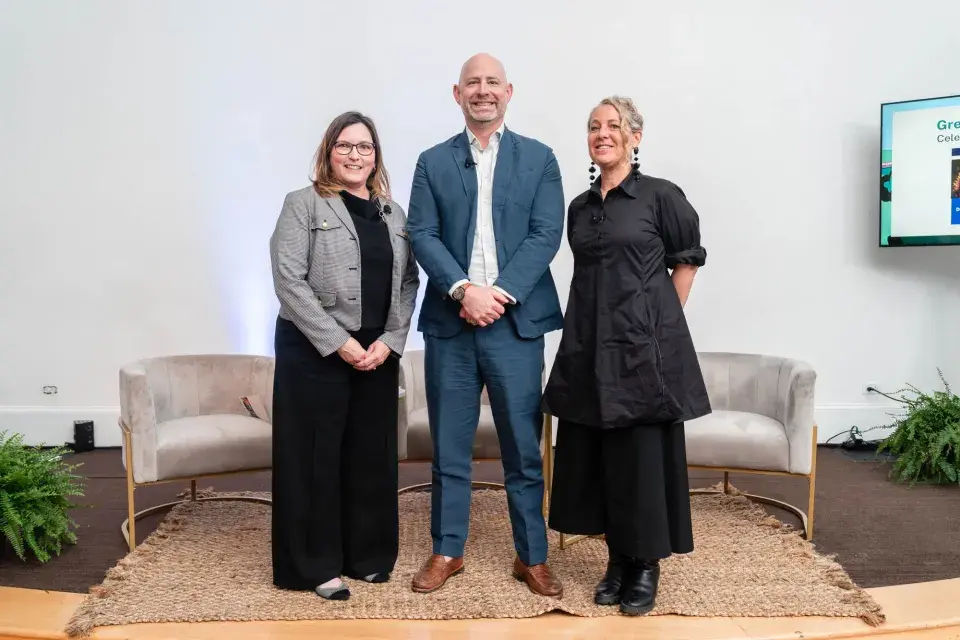
Jennifer Leone, assistant commissioner and chief sustainability officer of New York City’s Department of Housing Preservation and Development, described how the city drew from Enterprise Green Communities to embed forward-looking climate data directly into affordable housing design guidelines.
The response from developers, she said, was overwhelmingly positive. “We put it out there and nobody flinched. They said, ‘We can do this.’”
Michael Newman of the Insurance Institute for Business & Home Safety underscored that solutions to reduce damage and displacement exist — and need to be communicated effectively.
“Risk reduction needs to be science-based, it needs to be verified, and then it needs to be translated to the property insurance industry in a way that they can ingest,” he said.
Speakers acknowledged that the cost of inaction — lost homes, rising premiums, and community disruption and disaster — falls most heavily on residents with the fewest options to recover. At the same time, the discussion pointed forward: resilience is no longer about reacting to damage, but about building homes that perform under stress from the start.
The Next Chapter Begins Now
In a call to action, Janis Bowdler, president of Enterprise’s Solutions Division, returned to the sense of urgency and possibility that shaped the day.
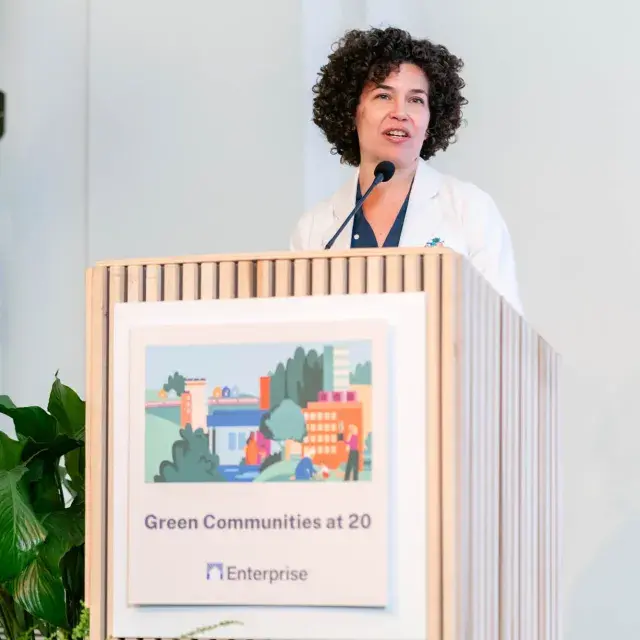
“We are in a window of opportunity,” Bowdler said, pointing to national attention on housing affordability and bipartisan support for the Road to Housing legislation. “We’re here today because we agree that it’s not just about building more housing. The question is how we build it.”
For Bowdler, that question drives home why Green Communities matters now more than ever.
“Simply building units is not enough,” she said. “We have to deliver housing where families can thrive — where their health is prioritized, where they can stay over decades.”
The stories shared throughout the day of lives changed — from lower utility bills to healthier indoor environments to buildings that weather disasters with minimal disruption — make clear that what’s at the heart of Green Communities is no longer theoretical.
With federal action promising to open the door to expanded housing production, the responsibility now is to ensure that new housing reflects what the field already knows — and has proven — works.