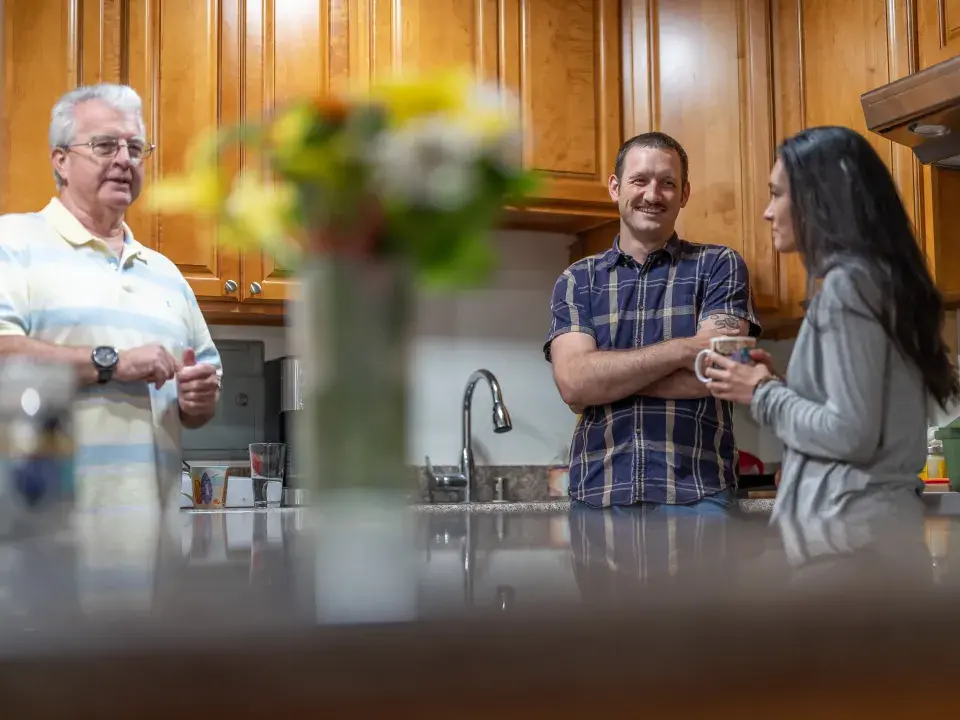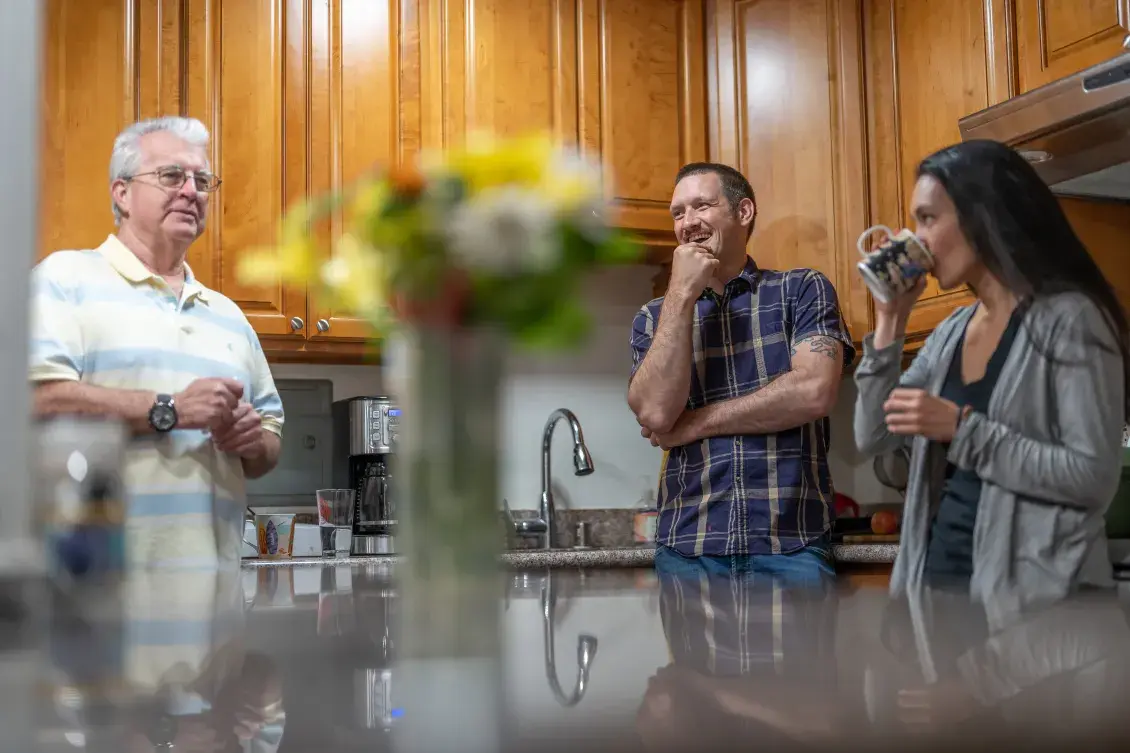
“What do you get when you get back home?” asks Bernadette Butler, director of the Housing Lab at Impact Justice. “In my house, I am greeted by my husband and my two girls. Sometimes we play board games around the table, sometimes we cook together, or we do family movie night.”
No matter what makes home feel like home, Butler believes it should be available to every human being — including people returning to the community from prison.
In reality, reintegrating into society can be a harsh experience for formerly incarcerated people. For many, it brings discrimination, legal barriers, and countless hurdles that make routine parts of daily life — buying groceries, finding a job, or seeing a doctor — feel almost impossible. But nothing is harder than finding a place to live.
People exiting the carceral system are 10 times more likely to become homeless than the general population, which partly explains high rates of recidivism for many individuals impacted by incarceration. Two-thirds of the roughly 500,000 people released from prison each year are rearrested within three years, and 40% return to prison. They are trapped in what Butler calls a “cycle of harm”: prison, homelessness, prison.
Rethinking Reentry Housing
The Homecoming Project aims to interrupt that unrelenting circle. Developed by Impact Justice — a nonprofit working at the intersection of research and innovation in the criminal justice space — the program has already helped provide stable housing to 260 people. Butler’s team is now supporting other organizations in replicating the model through the Housing Lab, a portfolio of programs at Impact Justice that tackle the nation’s overlapping reentry and housing challenges.
The concept is simple. The Homecoming Project matches individuals who have served sentences of 10 years or more with hosts who have a spare room in their home. Participants are welcomed into a stable living environment for six months, while hosts receive a stipend — about $10,000 over the course of the program.
Launched in 2018, the Homecoming Project has a remarkable track record. At the end of the six month-program:
- 100% of participants leave the program with housing, with 88% moving on to long-term, stable housing upon graduation
- 98% obtain full-time employment or pursue educational opportunities
- 0% have returned to prison while in the program
In 2020, an early iteration of the innovation earned Impact Justice one of six $2 million grants from the Housing Affordability Breakthrough Challenge — a competition led by Enterprise Community Partners and supported by Wells Fargo.
The Homecoming Project creates an alternative to transitional housing, often the only housing option for returning citizens. While such programs provide temporary shelter, they may involve regimented schedules, mandatory check-ins, crowded dorms, and frequent screenings that can “mimic the conditions people just came out of,” says Butler.
Impact Justice offers more than housing — it provides a critical stepping stone for individuals returning to the community in settings designed to mirror a traditional home environment. Butler says participants often describe the experience as “coming home with dignity.”
“Our inspiration was the sharing economy,” says Butler. “What if we used a concept like Airbnb — but made it accessible to people who need a second chance, a chance to rebuild their lives? That's how the idea was born.”
A Personal Mission
For Butler, growing the Homecoming Project is personal.
Raised in a Dominican family in New York, she saw firsthand how access to opportunity can shape a life. She was fortunate to receive a scholarship to attend a private school that set her on a path to college. Her siblings, however, had a more turbulent high school experience that took an enduring toll on their lives.
“That experience showed me that while potential is equally distributed, opportunity is not,” she says.
While in college, Butler taught at a federal prison in Virginia. One student told her, “If I'd had a teacher like you, I don't think I'd be here today.” The moment stayed with her — and is carried forward through the Homecoming Project: access, stability, and support can change the course of a person’s life.
Building Trust and Community
The Homecoming Project is intentionally designed for participants who are returning from long prison sentences — a group with low rates of recidivism but some of the highest rates of homelessness. Before a placement occurs, both the community host and formerly incarcerated participant undergo a thorough screening process. Once approved, they meet to ensure both parties are comfortable with the match. If they agree to move forward, they sign a contract that outlines shared expectations and house rules.
“Take your shoes off at the door, no dishes in the sink — those kinds of things,” says Butler.
Throughout the six months, a case manager provides ongoing support, checking in regularly and connecting the participant to resources and services that support successful reentry.
Hosts also receive monthly check-ins with a dedicated staff point of contact and training sessions, such as trauma-informed hosting, that position them to better understand and support their new roommates, when needed.
In many cases, the relationships extend beyond the program. Some hosts have welcomed additional participants in their home, while others maintain lasting friendships. Butler remembers one participant whose host, a writer, encouraged him to document how his experience training dogs while incarcerated helped him process trauma. With that support, he published a book.
Scaling Impact
Support from the Breakthrough Challenge has helped the Homecoming Project expand from serving a handful of individuals to nearly 300 participants to date.
In-person and online convenings with fellow winners "put us in touch with big thinkers in the national housing and innovation space,” Butler says. “A lot of big ideas are shaped in those workgroups.”
Among them is a broader vision: building a housing and reentry technical assistance model, with the Homecoming Project serving as a blueprint.
Despite a volatile funding landscape, Impact Justice is supporting reentry housing efforts in cities like Seattle and Austin, and working with organizations and public institutions interested in drawing from its model to launch similar initiatives across the country.
For Butler, the innovation’s growth represents more than increased housing capacity. It reflects a shift in how people returning from incarceration see their futures — and how society views them.
“Despite the barriers and roadblocks placed in their way, people are determined to rebuild their lives and contribute meaningfully to their communities,” she says.
Sebastian Escalón is a journalist based in Massachusetts. Read his earlier articles in this housing innovation series: A Second Skin for Affordable Housing and A Fund That's Opening Doors to Homeownership.