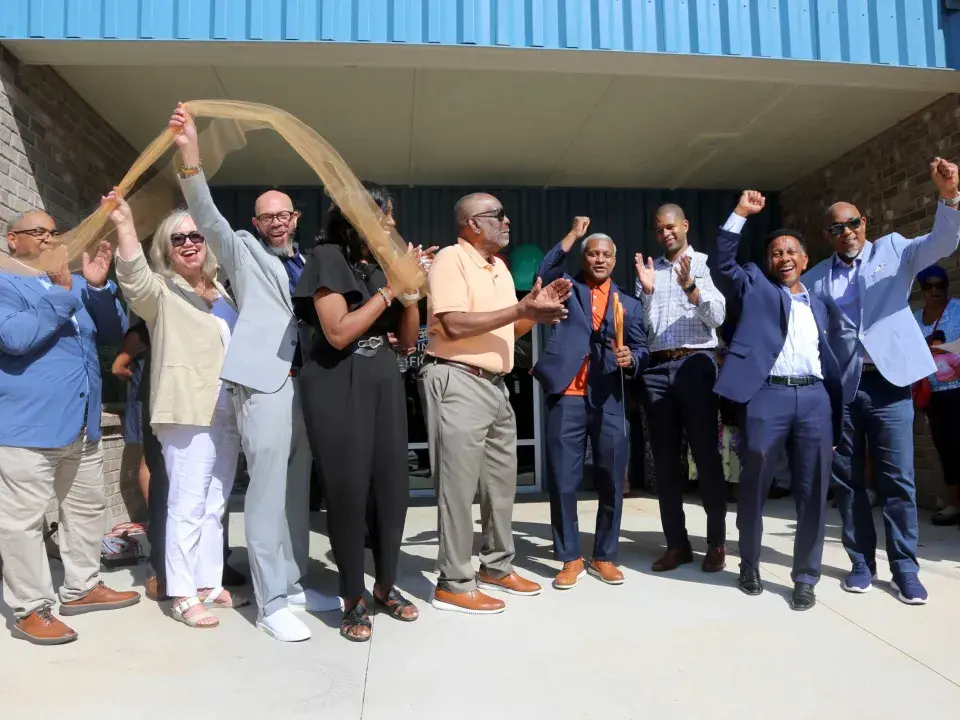
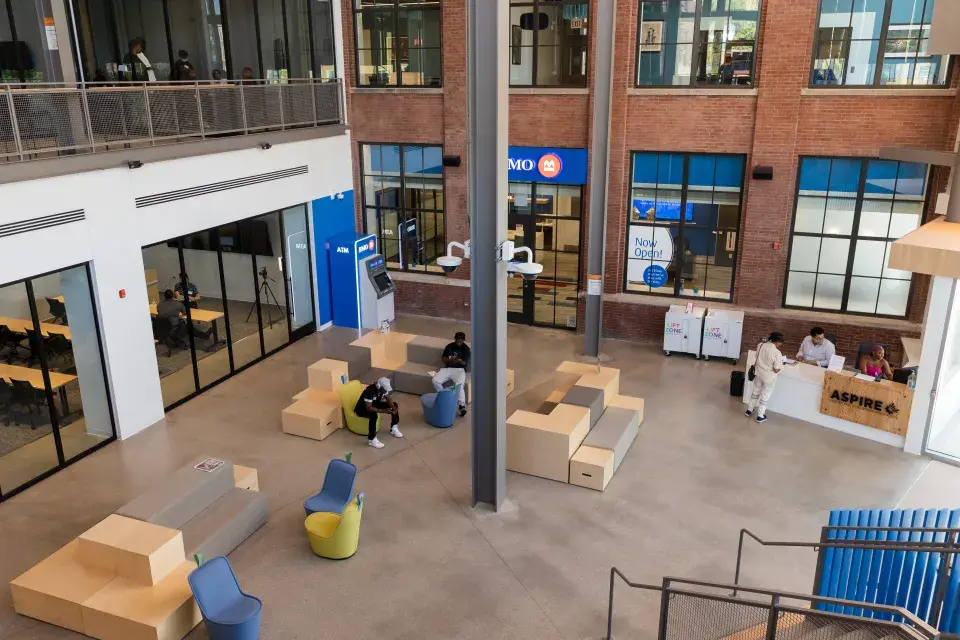
Emmet Elementary School was built in 1911 and served generations of students before it was closed by the city of Chicago in 2013. Today, the historic building has been reimagined as the Aspire Center for Workforce Innovation, a 74,000-square-foot hub with workforce training, financial literacy resources, and indoor and outdoor community space.
Aspire — founded by local nonprofits Austin Coming Together (ACT) and Westside Health Authority (WHA) — seeks to connect residents with better employment opportunities by providing training for high-demand manufacturing careers, financial coaching and services, and other job-readiness supports and community resources. After the center opened on Juneteenth in 2025, more than 980 workers were on track to be trained in that first year. Aspire expects to train 10,800 community members annually going forward and aims to increase the income of at least 500 community members by 2030.
We didn’t want the closing of a school to continue to be a point of disappointment for our community. We needed a development that catalyzed and challenged us to go higher, do more.
Darnell Shields, ACT’s executive director
The rebirth of the property was financed in part with $8.5 million from Enterprise Community Partners’ New Markets Tax Credit business line and $3.3 million from the Enterprise Community Loan Fund, one of the largest nonprofit community development financial institutions (CDFI) in the country.
According to the U.S. Bureau of Labor Statistics, 14.4 million adults are outside the labor force but want a job, with health issues and lack of access to supports cited as prominent barriers. The situation is especially urgent in Austin, where unemployment was 3.8 times the national average in 2025.
“It shows there’s investment in the community again,” said Cedric, an Austin resident who is part of an Aspire training program. “When you see people coming here, learning, getting jobs — it’s a good thing for Austin.”
We spoke with Cedric, a community member featured in our latest Social Return on Investment Report, about the opportunity he’s found through Aspire and the impact it could have on his community.
What career are you pursuing?
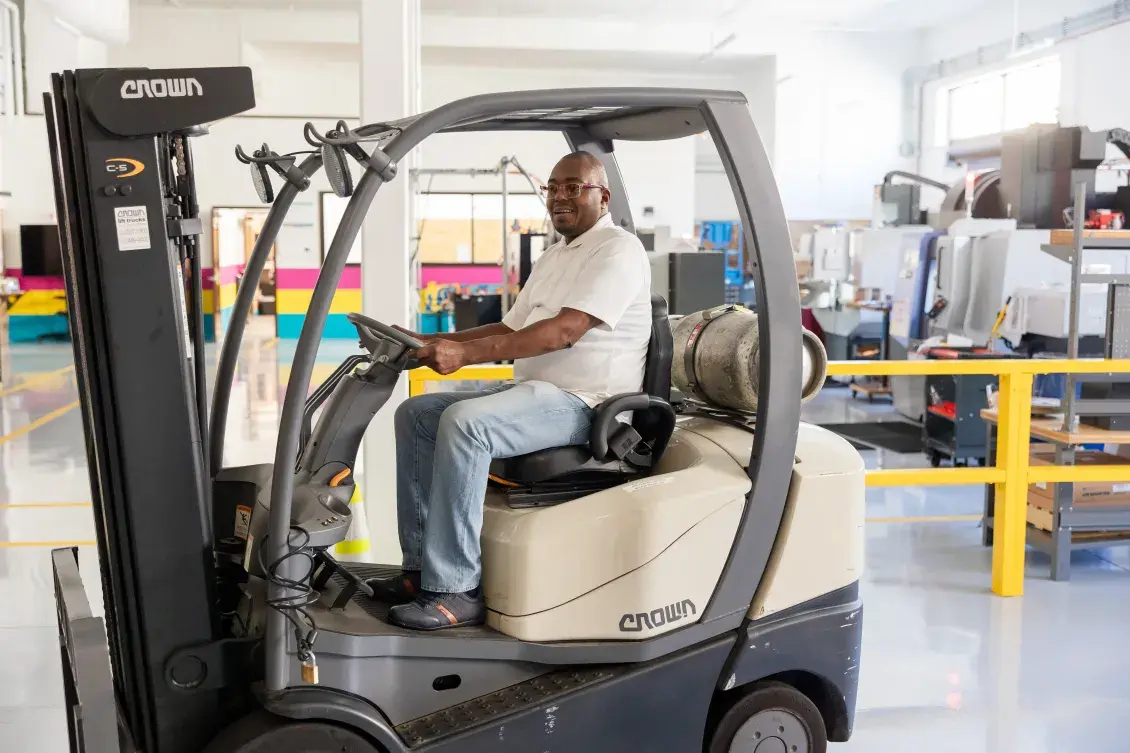
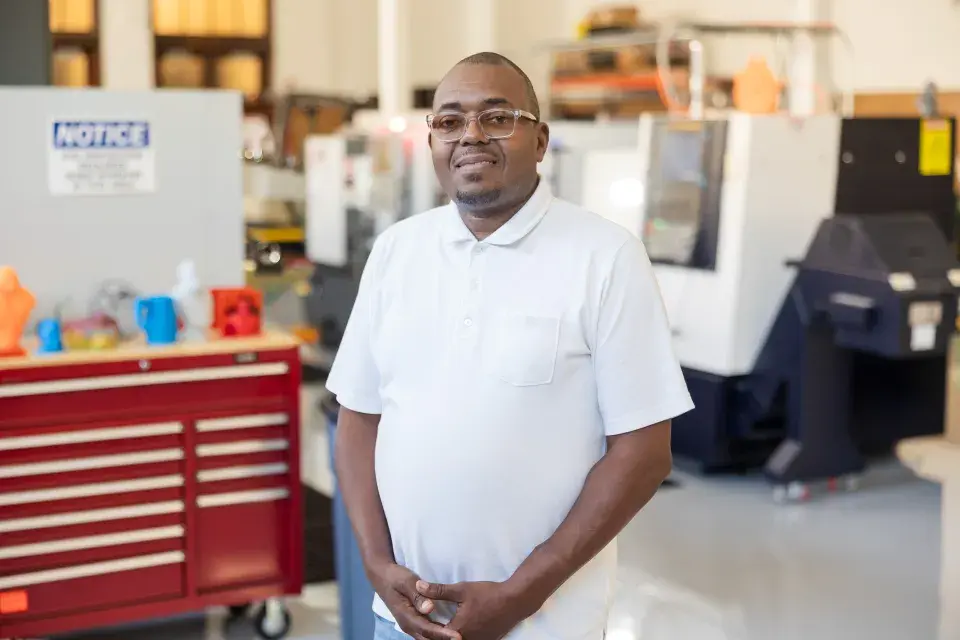
I’m finishing up my CNC certification — CNC stands for Computer Numerical Control. You write a program to create a product, then go to the mills and lathes and actually make it. You have to be precise, even down to ten thousandths of an inch.
How did you decide on this path?
I’m kind of a nerd with that stuff. I went to Lincoln Tech a few years ago for automotive technology, so it’s in the field. I’ve had health issues since — renal problems and eye surgeries — and I wanted to get back to work, but I couldn’t do any heavy lifting. CNC looked like something I could really do. It’s hands-on but not too physical, and it’s a good kind of challenging.
What does the Jane Addams Resource Corporation’s (JARC) training program mean to you?
It really got me back into job readiness — coming to class every day, getting in that routine again. JARC also helps with everything else: updating your resume, mock interviews, financial training. I’d been out of work for a while, so I needed a comprehensive approach to get back in the swing of things.
One of the best parts is that the training is free. If I had gone to a city college, it would’ve cost me $8,000. With JARC, I didn’t have to take out any loans. It just felt like the stars were aligned, like this was meant for me.
What are your overall career goals?
I want to become a Level 1 CNC machinist, then move up. I’m starting to learn CAD and CAM — that’s the software for designing and programming. Eventually, I’d like to own a mill or lathe and make parts, maybe sell them to the auto industry.
What do you think this resource brings to the neighborhood?
It’s lit up and full of life — you can feel the energy when you walk by. It shows there’s investment in the community again. When you see people coming here, learning, getting jobs — it’s a good thing for Austin.
What difference could job training make?
Entry-level CNC pays around $22 an hour — about $40,000 a year. That’s decent money, especially when rent is $1,800. You can save, maybe buy a home. It’s a start toward stability, and it keeps more money right here in the neighborhood.
If you’re looking to upgrade your skills, this is where you start. When one of us moves up in Austin, it makes room for the next person to do the same. It’s not just a class — it’s a better way of life.