
Missed rent isn’t just a crisis for individual families; it’s putting New York’s affordable housing system at risk. Since the COVID-19 pandemic began, back rent has been a major challenge for both tenants and the providers who run affordable housing.
For tenants, missed rent often reflects deeper financial instability and can place households at risk of eviction, which can have lasting consequences for families’ health, credit, and overall well-being. For providers, rent arrears have compounded an increasingly difficult operating environment: Operating expenses have increased by approximately 40% since 2017, while economic occupancy has declined to roughly 90%, falling below historical underwriting standards. The share of operators with collections below 80% has grown from 3% to 11% between 2017 and 2024.
This widening gap between income and expenses has placed significant strain on affordable housing providers, with Enterprise finding that 57% of affordable housing projects in its portfolio had negative cashflow in 2024. Together, these pressures create a dual challenge: preserving tenant stability, while also safeguarding the operating budgets that providers rely on to maintain buildings, pay for essential utilities such as heat and hot water, and preserve safe, quality affordable housing. As this trend continues, it further puts a strain on the organizations that provide affordable housing, limiting their ability to invest in additional units and provide other essential services to the community.
In May, Enterprise New York hosted the Rent Arrears Action Lab, a day-long convening of 27 NYC affordable housing providers interested in learning from each other and other experts about approaches to addressing rental arrears. The Lab was grounded in the central premise that preventing eviction and strengthening portfolio sustainability are not competing goals. Instead, when providers can foster trust, intervene earlier, communicate effectively, connect tenants to available resources, and embed eviction prevention into property management practices, they are better positioned to support both residents and the financial viability of the city’s affordable housing stock.
Through the Action Lab, a consistent theme emerged that resolving arrears requires more than collecting balances after they accumulate — it starts with the everyday practices that shape when and how operators identify risk, whether residents understand their options and enter engagements with housing providers with a level of trust, and whether both parties are able to engage before a housing crisis escalates. Below are key takeaways from the initial Rent Arrears Action Lab convening.
Resident Engagement: Communication & Trust-Building
While arrears often appear first as a balance on a ledger, resolving them depends on whether providers can reach residents early, communicate in ways that reduce confusion or fear, and build enough trust for tenants to share information and accept support. To help providers examine those dynamics, Micah Melia, Head of Research for the Americas at BIT — a global research and innovation consultancy that uses an understanding of human behavior to improve systems and policy — led a workshop on the barriers and enablers that may influence a tenant's ability to pay their rent on time and respond to outreach.
BIT’s prior work on rent arrears has demonstrated the power of timely, behaviorally-informed outreach. For residents facing financial instability, rent may be one of several urgent pressures competing for attention alongside work, school, caregiving, health needs, and other household expenses. Feelings of stress, shame, or avoidance around missed rent can make it harder for residents to respond to outreach, even when assistance or a workable resolution is available.
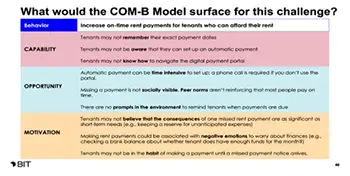
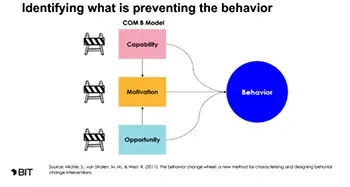
Action Lab participants explored these challenges using the COM-B Model, a tool that examines how an individual's capacity, opportunity and motivation work together to enable or inhibit behavior. Applying this framework helped providers think deeply about why a resident is not engaging, and what kind of targeted interventions may be most effective.
Providers identified barriers their tenants may be facing, explored opportunities to stratify residents based on different rent paying behaviors, and workshopped how this more nuanced understanding could shape outreach. The discussion underscored that resident engagement is not only about sending more notices; it is about designing communication and internal workflows that make earlier resolution more likely.
BIT’s behavioral tools reinforced the value of a multipronged approach that differentiates outreach based on tenants’ specific barriers, using language and timing tied to the behavior change that could lead to more consistent rent payment. For example, tenants who cannot consistently afford their full rent may benefit from different resources and outreach than tenants who are deprioritizing rent over other needs, or those experiencing a short-term financial shock. This approach also benefits from building stronger relationships between tenants and property managers, better coordination with resident services teams where they exist, and regular data review to identify trends before arrears become unmanageable.
Practitioner Spotlight: Centering Stability in Property Management
Tenant stability remains a priority for affordable housing providers, and several Action Lab participants highlighted ways they embed that in day-to-day property management practices. Rather than treating arrears solely as a collections issue, providers discussed approaches that recognize the costs and harms of eviction for both tenants and landlords, including legal expenses, staff time, lost rent, and the destabilizing impact of housing loss on residents and families.
WinnCompanies shared how its Housing Stability Program centers resident wellbeing while addressing rental arrears. The approach combines tools such as financial assistance, on-time rent payment incentives, coaching, and structured prevention support to create “off-ramps” for tenants experiencing instability. Together, it reflects a broader shift in property management practices that go beyond reacting to missed payments, and toward fostering stability before arrears escalate.
Incentives and wealth-building tools can also reinforce positive payment patterns and help residents build longer-term financial stability. These can range from positive-only rent reporting or small incentives for on-time rent payment, to more expansive models like Enterprise’s Renter Wealth Creation Fund, which helps renters achieve upward mobility through cash back for on-time payments and by sharing capital proceeds if a property is refinanced or sold at a profit.
That same prevention-oriented approach can also inform how providers respond when arrears have already accumulated. Connected Communities, a 501(c)(3) nonprofit resident services provider and Winn affiliate, shared its Coordinated Eviction Prevention program, an arrears forgiveness pilot that offers tenants a pathway to address arrears through structured payments and an opportunity for balance write-offs. Models like this can build trust with the tenant and help residents reestablish regular payment habits, while giving providers a clear framework for resolving older balances.
No single incentive, amnesty model or prevention strategy is a silver bullet. Providers must carefully consider when forgiveness is appropriate, how eligibility is determined, what expectations are communicated to residents, and how write-offs fit within broader financial and asset management constraints. But when implemented thoughtfully and targeted to the right circumstances, these approaches can meaningfully expand the toolkit beyond standard collections and eviction filing activities, pairing arrears prevention with structured incentives, resident services, and financial tools.
Using Technology to Strengthen Upstream Approaches
Technology and AI tools also emerged as areas for continued exploration, particularly as providers look for ways to strengthen administrative capacity and free up staff time for meaningful resident engagement. Used thoughtfully, these tools can help streamline routine processes, improve responsiveness, and create additional pathways for tenants to raise concerns or request support.
For example, tenant-facing chatbots can improve accessibility for residents who have difficulty reaching management during business hours, or who feel uncomfortable initiating conversations about sensitive issues directly with a landlord or property management staff. Enterprise Community Development gave insight into how Enterprise’s property management team leveraged AI tools such as EliseAI to support functions ranging from sending customized payment reminders, to troubleshooting a clogged drain and issuing a maintenance ticket if-necessary.
Beyond resident-facing tools, there is significant potential for technology to strengthen internal workflows, data management, and reporting. Better systems can help providers identify and stratify arrears trends earlier, prioritize outreach, tailor engagement strategies, track follow-up, and reduce the time staff spend piecing together information across teams or platforms. These tools are not a substitute for relationship-based engagement, but they can give operators better information and more time to respond before issues escalate.
The broader opportunity is to use technology not simply to automate interactions, but to build stronger systems around resident stability. With thoughtful implementation — including attention to data quality, staff training, resident digital literacy, and appropriate disclosures — these systems can improve outreach, early intervention, and follow-through on the resource navigation and administrative processes that are often central to resolving arrears.
Rental Assistance & Subsidy Best Practices
This same principle applies to rental assistance and subsidy practices, where early coordination, clear processes, and strong partnerships can help prevent or resolve arrears while advancing both tenant stability and portfolio sustainability. A crucial element of addressing arrears is ensuring that tenants have access to the rental vouchers and public assistance resources for which they are eligible and are able to maintain subsidies once secured. While New York City has a wide range of programs designed to support housing stability, the system can be difficult for both residents and housing providers to navigate. Detailed documentation requirements, fragmented processes, and significant follow-up can delay assistance, even when a tenant may ultimately qualify.
RiseBoro Community Partnership, an affordable housing and social service provider, shared best practices drawn from Home 4 Good and its work helping tenants and landlords to jointly resolve arrears. While some housing providers may feel that they need to initiate the legal eviction process to demonstrate urgency or expedite access to One Shot Deals, eviction filings are not required to apply for emergency assistance — and in fact, arrears can be resolved more quickly, at lower balances, when tenants are supported before a case is filed. This session explored how housing providers can help tenants make the clearest case possible for applications while avoiding a filing, including by providing formal rent demand notices, and ledgers that clearly show how the rent balance has changed over time. That documentation can be especially helpful when it reflects a tenant’s efforts to repay arrears, enter into a structured payment plan, or make consistent forward rent payments. And in some cases, targeted landlord write-offs can also help secure emergency rental assistance, by reducing the balance to an amount that a public agency, charitable funder, or tenant can realistically resolve.
Subsidy maintenance is another key area of focus. Providers discussed the importance of identifying voucher or recertification issues early, helping tenants gather required documents, and improving coordination between property management and administering agencies. One practical recommendation was to issue lease renewals earlier, to better align with voucher recertification deadlines; encouraging residents to include the new rent amount in their recertification package upfront reduces the risk that administrative timing issue will contribute to subsidy interruptions or unaffordable tenant rent shares.
Together, these practices show the value of building clearer systems around rental assistance and subsidy work. When providers can track documentation, coordinate across teams, prevent lapses in voucher payments, and use targeted write-offs strategically, they are better positioned to help tenants access resources and resolve arrears before they escalate into legal action.
Looking Ahead
Long-term solutions to support affordable housing operators and stabilize families will require sustained investment and policy action. At the same time, the Rent Arrears Action Lab highlighted some of the many practical strategies that providers are already implementing to strengthen their response to arrears and support residents: Improving resident communication, building partnerships with service providers and public agencies, using data and technology effectively, expanding the tools available before eviction filing, and building clearer systems for connecting tenants to rental assistance and subsidies. No single strategy will resolve the rental arrears crisis on its own, but together, these practices can help providers support residents, reduce avoidable legal action, and preserve New York’s affordable housing stock and the operators that sustain it.