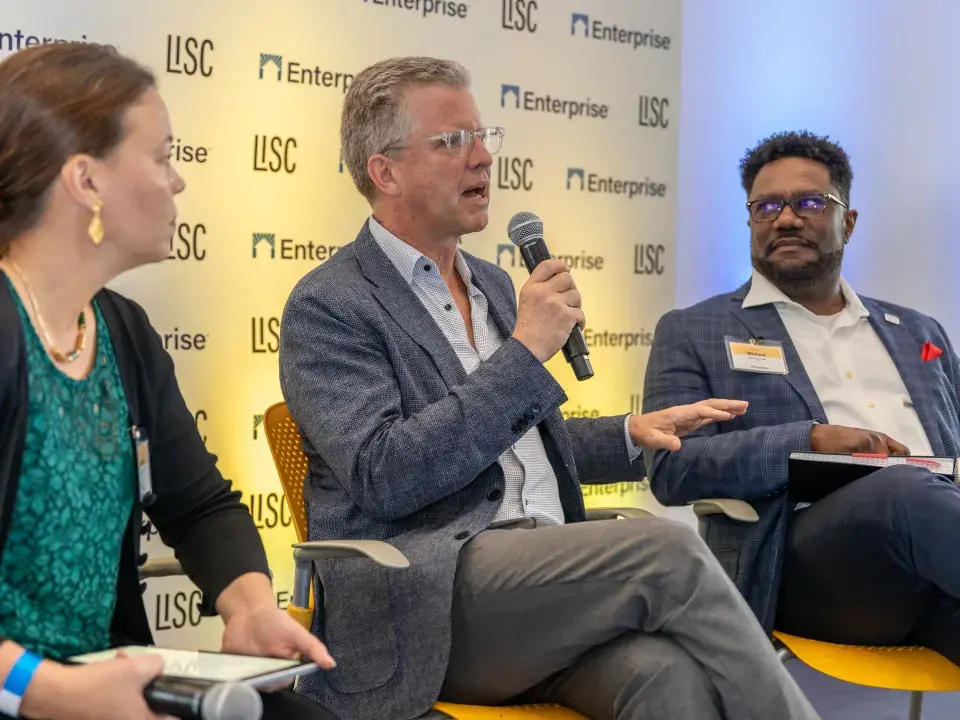
This virtual conversation explores the essential elements of a housing trust fund with experts in the field. Speakers explore considerations for communities seeking to implement this tool for investment in affordable housing, homelessness prevention, homeownership initiatives, and more.
Discussion topics include:
- Defining the goal of your community’s housing fund and building support
- Establishing a governance structure and revenue sources
- Deployment of funds, impact reporting, and other post-establishment considerations
- Real-world examples of common considerations, challenges, and solutions
Materials:
Building a Housing Trust Fund Transcript
00:08:10.000 --> 00:08:26.000
a paper that enterprise community partners, Enterprise Southeast wrote in 2024 talking about housing trust funds in Georgia, looking at the different models of housing trust funds in Georgia and across the country. So encourage you to explore that paper
00:08:26.000 --> 00:08:33.000
And I'm going to turn it over to Jerah.
00:08:33.000 --> 00:08:49.000
Thank you, Beth. Hello, everyone. Again, my name is Jerah Smith. I'm the Associate Director for Housing Solutions at Enterprise Advisors, the national mission driven consultancy within Enterprise Community Partners. Let's start with demystifying Housing Trust Funds
00:08:49.000 --> 00:09:05.000
When people first hear Housing Trust Fund, it can often sound onerous or intimidating, when in reality, think of it simply as a dedicated, flexible, municipal investment fund created by local law to protect and build housing locally.
00:09:05.000 --> 00:09:20.000
To help make it easier, we worked with a health advocacy organization called City Health to produce a housing trust fund action guide, and in that guide, there's five key considerations for building a housing trust fund. Number one, defining your goal
00:09:20.000 --> 00:09:31.000
What do your neighbors actually need? Coalition building. Who needs to be at the table? Number three, funding. How do we keep the piggy bank filled? Number four, governance.
00:09:31.000 --> 00:09:37.000
How… who decides how dollars are spent? And number five, measuring impact. How do we prove that it works?
00:09:37.000 --> 00:09:52.000
You don't have to reinvent the wheel. Cities and counties across the Southeast have already blazed this trail, as Beth alluded to, with the right roadmap and the right technical support, your community can tailor a fund to match your exact local scale and needs. So, let's zoom
00:09:52.000 --> 00:09:57.000
to the first phase purpose and people. Next slide, please.
00:09:57.000 --> 00:10:03.000
All right, so before we talk about the millions of dollars and the legal bylaws
00:10:03.000 --> 00:10:18.000
Let's start with people. That is, of course, our North Star, a housing trust fund is only as strong as the clarity of purpose. Every dollar deployed downstream traces back to a specific local housing needs centered around
00:10:18.000 --> 00:10:27.000
Person or one household, one family. So we always want to make sure to remember to keep those people front and center. Next slide, please.
00:10:27.000 --> 00:10:29.000
All right, so defining your housing
00:10:29.000 --> 00:10:31.000
trust
00:10:31.000 --> 00:10:46.000
Let's start by grounding it in what we already know. You don't need to spend years commissioning a brand new research, you know, study. Look at your recent local housing assessments, consolidated plans, or regional data to see what real gaps exist, whether it's
00:10:46.000 --> 00:11:03.000
Rising rents or home repair needs for aging seniors, or just the total shortage of starter homes. Number two, set clear and measurable goals. Vague goals like fixing homes make it hard to measure success or make funding decisions
00:11:03.000 --> 00:11:20.000
Instead, get concrete. Are we aiming to preserve 100 naturally occurring affordable rental units, or help 50 working families with down payment assistance, or prevent displacement in a specific neighborhood? Number three, of course, though, the caveat is
00:11:20.000 --> 00:11:23.000
The need to balance specificity with flexibility.
00:11:23.000 --> 00:11:35.000
You want to be clear about who to serve, like those at 50% AMI and less, but you don't want eligibility to be so restrictive that local partners can actually use the dollars flexibly.
00:11:35.000 --> 00:11:49.000
So now to look at how different communities in our region actually translate these guiding principles into distinct programs and real world loan products, I'm going to hand it over to Tammie to walk us through some concrete examples. Next slide, please.
00:11:49.000 --> 00:12:09.000
Thanks, Jerah, and I'm so excited to be here today. And thank you, Beth, for including us at LEH as well. Again, some common considerations in setting up a housing trust fund. I actually established a housing trust fund in Charleston, South Carolina back in 2003, a local housing fund, so have had some different considerations
00:12:09.000 --> 00:12:39.000
As Jerah mentioned, sort of what is the why, you know, in defining our guiding principles, the why in which we're setting up this local housing trust fund in the first place. So thinking about what will guide our core decisions on where and what to fund, as Jerah mentioned, prioritizing local housing needs. And so every local community is different, and so kind of evaluating that what types of housing projects and programs should be prior
00:13:05.000 --> 00:13:33.000
to look at special considerations like very specific target neighborhoods, very place-based strategies. Again, are there environmental concerns that we're thinking about? What are our local development support mechanisms? So again, thinking about what are these core principles that are sort of ROI for our local housing trust fund, and then affordability. Of course, we're investing very valuable resources. So how long will these properties be affordable once they're completed or renovated next slide please
00:13:33.000 --> 00:14:03.000
Once we kind of look at what our why is and what these guiding principles are, we also want to then dive a little bit deeper, again, what are those programs and products for consideration? Again, every community across the Southeast or the Northeast, or whatever area we're in looks
00:15:30.000 --> 00:15:33.000
how many units are you hoping each of
00:15:33.000 --> 00:16:00.000
financing would serve. What are your area median income requirements? Are you going to do the full gamut? Are you going to focus on a very specific area median income? Again, a lot of times housing trust funds are filling the needs that federal funding or state funding do not fill. So a lot of times CDBG, home funds, other funding sources that local governments may receive. The goal is that the housing trust fund may be serving a population or a need that those funds do not serve. So be thinking about that in these projects
00:16:00.000 --> 00:16:30.000
project-level considerations. And again, is the project ready? How quickly do you need to deploy these funds? Some housing trust funds have received federal stimulus resources, so sometimes those funds need to be spent sooner than later. So again, you'll be taking those types of things into consideration. Of course, looking at your market. What does the market need? Every market need is different. Again, you may be looking at more missing middle, that that's a real need for your community. So you may be looking at that type of opportunity.
00:17:06.000 --> 00:17:21.000
And then again, how long of the affordability are you thinking? Is it going to be in 99 year deed restriction? Will you fund to a housing land trust? So again, thinking about the long-term value of the financing that you're delivering will also be an opportunity
00:17:21.000 --> 00:17:23.000
Next slide.
00:17:23.000 --> 00:17:53.000
So just to give you some snapshot examples of some housing trust funds here in the Southeast that I'm somewhat familiar with, we at LEH have worked with a couple of these housing funds, and again, we thought about priorities, some of these communities identified very specific areas
00:18:02.000 --> 00:18:32.000
that was done and they really targeting not only low-income housing tax credit projects and filling gaps, but also really trying to create a robust single family housing pipeline in addition to looking at acquisition as this area continues to accelerate and becoming less affordable. And then again in South Carolina, we have a regional example where a nonprofit is looking at eight different jurisdictions that came together to provide funding sources. And then in Greenville, a city and county came together to launch
00:18:32.000 --> 00:19:02.000
their housing trust fund and very specific on certain AMI levels. And then they also got involved in acquisition of naturally occurring affordable housing. So again, they also were looking at missing middle. So again, you could see, you know, very different target markets in two different states and really approaching it very differently to really meet the local needs. So those are just some examples in framing out a housing trust fund that you might want to take into consideration
00:19:04.000 --> 00:19:06.000
It's over to me, no problem.
00:19:06.000 --> 00:19:36.000
Thank you, Tammie. Those are some really cool examples
00:19:39.000 --> 00:19:43.000
a genuine… so that they have, excuse me, so that they have and feel
00:19:43.000 --> 00:19:45.000
genuine sense of ownership, so that they
00:19:45.000 --> 00:20:01.000
have a stake in the game and their voice is listened to. Make sure to help that happen. Remove barriers to participation. Make engagement more accessible. That means hosting conversations at convenient hours, offering food or childcare, and meeting people where they are instead of relying solely
00:20:01.000 --> 00:20:14.000
formal weekday public hearings. I'll give an admittedly self-serving example. If you're doing… if we're doing community engagement events in my town, you know, 8 times out of 10, 9 times out of 10, it'll take place in
00:20:14.000 --> 00:20:44.000
the early evening. But as a parent of two kids, five and under.
00:21:33.000 --> 00:22:03.000
doing that, whether that be through a comprehensive plan or a balanced housing study like Greenville did. So the Greenville Housing Fund, you know, did that. In the regional aspect, the Beaufort-Jasper Housing Trust Fund had a regional study, and from that regional study, one of the recommendations was to launch a housing trust
00:22:10.000 --> 00:22:38.000
Some of the guiding principles and some of the product and program outline that I mentioned earlier of, like, what the Housing Trust Fund should and could do and why, and for whom. But in addition, as Jerah mentioned, advocacy is super important. So housing coalitions provide that key advocacy effort, and there's a variety of organizations that have done this all the way from the statewide effort, like the Sadowski Act in Florida to bond referendums here in Charlotte, the Charlotte Housing Fund that's continued to be funded
00:22:38.000 --> 00:23:08.000
As well as some local grassroots efforts. And then, as Jerah mentioned, the folks that are going to utilize or access these resources are really important. So many times your nonprofit and for-profit developers should be at the table providing feedback. So again, in making Bibb and Athens-Clark, we did developer surveys. We identified what their needs were so that they could actually help tell us what would be the right products and programs
00:23:27.000 --> 00:23:57.000
The ongoing advocacy that's necessary to ensure these dedicated revenue sources are not only available today, but available ongoing. And again, the statewide advocacy is something we have seen really accelerate, and I know that enterprise is looking at this in Georgia, but for example, in South Carolina
00:24:01.000 --> 00:24:05.000
Yeah, thank you so much, Tammie and Jerah.
00:24:05.000 --> 00:24:20.000
We have some great questions in the chat, so I'm going to go through the two that we have. The first one is, can a housing trust fund be independent of the public sector? I think this is a great question. So either or Tammie, if you want to take
00:24:20.000 --> 00:24:23.000
That one
00:24:23.000 --> 00:24:40.000
Absolutely, and I think we're going to talk a little bit about governance and structure in the second part of our presentation. But in many cases, we are seeing where local governments actually are looking at nonprofits, either new nonprofits or existing nonprofits to lead the administration
00:24:40.000 --> 00:25:01.000
In many cases, it's because, one, the local government doesn't have the same flexibility of these non-governmental entities to really look at the range of products and programs that are most beneficial for community. And in some cases, like in Georgia, there are laws that prohibit local governments to set up these types of funds to then create revolving loan fund cycles
00:25:01.000 --> 00:25:23.000
Which then eliminate some of the programs and products that we might see as well. So those are just a couple examples of why it can be beneficial to have actually a separate entity outside of the government to do that. But there are some government entities in some states that do run these through their local government, like in Charlotte, for example, their housing fund is run through the city of Charlotte.
00:25:23.000 --> 00:25:25.000
Thank you.
00:25:25.000 --> 00:25:26.000
Jerah, go ahead.
00:25:26.000 --> 00:25:41.000
And I'll just add… yeah, I'll just add, you know, well, I second everything that Tammie shared, and really, you know, it comes down on to where you want the funding to come from and what you want the administration to… to look like. So, as Tammie said, really, it depends on
00:25:41.000 --> 00:25:51.000
on your goals, and there can… I don't think anybody's going to say that we should be chewing any capital away from housing development at this time. So anything that works.
00:25:51.000 --> 00:26:14.000
I would just add Beth, real quick to that one of the things that I think that makes me think of is actually being able to leverage philanthropy or other sort of bake investments. So whether that's CRA or program related investments or other types of funding sources, the flexibility sometimes of being outside of the government also allows you to leverage other resources that you may not be able to leverage in addition to the public dedicated dollars
00:26:14.000 --> 00:26:19.000
So that's another consideration when establishing the governance or the administration.
00:26:19.000 --> 00:26:35.000
Great, thank you. The next question is, are we only focused on residential or can these tools be adopted for use to serve commercial property purposes? And Tammie, I don't know if you've seen any examples of where housing
00:26:35.000 --> 00:27:05.000
funds have been used with commercial properties.
00:27:18.000 --> 00:27:29.000
There can be sort of a slippery slope of whether we're funding commercial spaces or not. But I have seen housing trust funds do mixed income, mixed use type projects and developments in some communities.
00:27:29.000 --> 00:27:57.000
Jerah, you may have also some examples, but that's sort of, it's usually established in those ordinance or legisl
00:27:57.000 --> 00:28:08.000
and starter homes for low-income families. So any examples of those investments in starter homes or preservation of starter homes?
00:28:08.000 --> 00:28:24.000
Yeah, and I mentioned Athens-Clarke County, which is launching their housing trust fund, and actually, when they did their affordable housing investment strategy study, one of the key buckets that they're focused on is single-family housing. And so one of the goals is within their neighborhoods
00:28:24.000 --> 00:28:39.000
Athens, preserving housing for legacy residents and looking at new first-time homebuyer opportunities in those neighborhoods as well as the growth continues. We've also seen where housing trust funds have done, and we think we're going to talk about this a little later
00:28:39.000 --> 00:28:55.000
Home repair. So again, trying to make sure that we're supporting residents to stay in their homes in addition to those that may be moving into the neighborhood. And then third, we've seen housing trust funds do a lot of down payment assistance programs. So, whether they're employer-assisted housing programs
00:28:55.000 --> 00:29:12.000
at the housing fund that I led, there was a lot of hospitals that were providing down payment assistance through our loan fund to deploy to employees for first-time homebuyers. So there's a lot of different ways that single-family and first-time buyers can participate with a housing trust fund
00:29:12.000 --> 00:29:30.000
Thank you, great. I just want to draw everyone's attention to the fact that there is a link in the chat now also to the Policy Action Guide from City Health and Enterprise that covers a lot of the information that we're talking about today on this webinar. Now I'm going to turn it over to Jerah to talk about funding and governance
00:29:30.000 --> 00:29:38.000
But there will be another Q&A opportunity later in the program, so please keep the questions coming. Thank you.
00:29:38.000 --> 00:29:53.000
Thank you, Beth. Okay. Will these questions actually were perfect teeing up for this section, funding and governance. Let's move into the actual mechanics of operating a housing trust fund. Now that we've established the why the funds exist and who informs it
00:29:53.000 --> 00:30:02.000
We can turn to the nuts and bolts of making it real. Where does the money come from, and how do decisions get made? Next slide, please.
00:30:02.000 --> 00:30:32.000
So, determining the funding source is far from just a fiscal decision. We all know, but it really has the most impact and has the highest potential to create a sustainable housing trust fund, especially if you have a dedicated and recurring
00:30:46.000 --> 00:31:07.000
always be able to partner with good projects. A dedicated stream means advocates don't have to fight for survival for every single budget cycle. Take the power of leverage, for example. Local trust funds have an incredible multiplier. National data shows that for every $1 invested by
00:31:07.000 --> 00:31:09.000
local housing trusts
00:31:09.000 --> 00:31:22.000
They leverage about $7.50 in private
00:31:22.000 --> 00:31:39.000
Partnerships are also key. They're key and they help expand the pie. Cities don't have to fund these alone and they shouldn't. Partnering with local community foundations or major regional employers, health systems and banks, they can help pool resources to meet your local goals.
00:31:39.000 --> 00:31:48.000
So what does that look like in practice? Let's take a look at a few standard funding tools available to local governments. Next slide, please.
00:31:48.000 --> 00:32:18.000
This is just a simple, just this, excuse me, this is just a sample. There's no one-size-fits-all tool. Every community's legal and economic reality is different, but just to quickly tour this menu, because I want to hand it over to Tammie as quickly as possible
00:32:23.000 --> 00:32:39.000
are tied to housing revenue directly to market transactions, so they can fluctuate with interest rates or how the housing market is doing. Short-term rental fees and linkage fees can help communities feeling the pressure of tourism or rapid commercial development ensure
00:32:39.000 --> 00:32:43.000
growth contributes to local workforce housing.
00:32:43.000 --> 00:33:13.000
So, state and local politics will shape which tools make the most sense for you, especially in our Southeast area. Tammie's going to walk us through how several communities across Southeast have navigated this and chosen their revenue streams. Next slide, please.
00:33:23.000 --> 00:33:50.000
It's 10 cents, it's funded, you know to the state, and then the state deploys those funds out. So that is an example of a dedicated revenue stream. And again, some of the organizations that I've had the opportunity to work with or I'm familiar with, a few listed here. And as Jerah mentioned, some were seeded with stimulus funding like ARPA. So in Macon Bibb, they did use their 7.5 to seed. I would say that that's a really exciting advocacy, although it's a one time
00:33:50.000 --> 00:34:20.000
opportunity that the foresight of the mayor and the council to say, like, this is such an important resource. It's going to be a one-time resource, and how do we actually launch our housing trust fund in a meaningful way? So being able to do that, I think, took a lot of leadership, and so again, they were able to launch their housing trust fund and have been underway for a couple of years now, so that's really exciting. And now they're looking at leveraging other Georgia State funding to actually accelerate the work that they're doing. Also in Athens-Clark County, they also were seeded with
00:34:20.000 --> 00:34:46.000
Some general fund money, but then also have implemented through their housing affordable housing investment strategy of inclusionary zoning funding stream. We're actually developers that are coming to the community that are building, whether that be student housing or market rate housing, are partnering with the city and the county to offer additional funding for affordable housing. So those developers may not be building affordable housing directly, but they're offering an incentive and a resource to then put into this housing fund
00:34:46.000 --> 00:35:01.000
to then be utilized. So actually working closely through benefits agreements or inclusionary zoning, whether that be voluntary or mandatory is another way to get developers at the table to help support your affordable housing needs, especially when they're not delivering those units themselves
00:35:01.000 --> 00:35:31.000
Again, I mentioned Beaufort Jasper County, which they also use ARPA money to seed, but the beauty of this particular effort was all those 8 municipalities came together in the Beaufort-Jasper area to commit a part of their ARPA funding to launch the regional housing trust fund, and then also committed to some sort of funding over a 10 year period. So again, and I also mentioned there's been some state appropriations and also accommodations tax that's been leveraged in South Carolina. So another those seed funds
00:35:31.000 --> 00:35:51.000
to help to launch future funds, which is really exciting. Again, we've seen local governments like in Greenville seed the actual housing fund, and then philanthropy back then by matching those funds. So as Jerah mentioned, it's also an opportunity to leverage philanthropy in certain markets when the local government comes in with some additional funding
00:35:51.000 --> 00:36:16.000
And then as Jerah mentioned, bond referendums is a great tool that Charlotte's been doing for many, many years, as well as the city of Charleston to really support affordable housing and then looking to leverage local philanthropy and bank investment to add more capital to the fund. And then Florida is one of the, I think, top examples out there that's been doing this since the 90s, which they have a statewide fund that then filters local funding to each local housing trust fund
00:36:16.000 --> 00:36:42.000
And then just recently they passed the Live Local Act, which was over $1.5 billion towards affordable housing, not just in their housing fund. I'll just add that caveat, but again, investing in affordable housing, which some of those funds went to the housing fund and then to local housing funds. So a variety of sources and a variety of examples. And again, but advocacy and ongoing commitment by the local partners is super important to keep these resources available.
00:36:42.000 --> 00:36:47.000
Next slide.
00:36:47.000 --> 00:36:48.000
Thanks, Tammie.
00:36:48.000 --> 00:37:18.000
So
00:37:24.000 --> 00:37:46.000
Help make it clear, have objective scoring matrices, transparent timelines, pre-application support workshops to the degree that's necessary. Those are all best practices. Last, be intentional about deployment. When rolling out your NOFOs, your notices of funding opportunities, timing matters, aligning with your local funding cycles with state
00:37:46.000 --> 00:38:16.000
LIHTC deadlines, for example, helps local developers assemble their gap financing much more seamlessly. And in my experience, you know, housing trust funds are very much part of a stack of capital. But deciding who manages the day-to-day operations, whether
00:38:17.000 --> 00:38:34.000
Great, thanks. And I know this question came up earlier in the presentation. So yes, many local governments do direct administration in some states. Again, as I mentioned, there is a preclusion to that, like in Georgia, where there's the gratuities law, which has some
00:38:34.000 --> 00:39:04.000
Challenges where local governments can actually deploy these directly, and so you definitely want to make sure that you understand your state laws to understand how your housing trust fund should and could be set up. In some states, you have to pass enabling legislation to then allow
00:39:54.000 --> 00:40:14.000
opportunity to create a new entity. And so again, Savannah has been doing this for quite some time, and they've been established for many, many years working side by side with the city and a CDFI there. And then Macon actually did create a separate 501(c)(3) because there was not an existing organization to actually lead this. And in Athens they're just now putting out an RFP for an
00:40:14.000 --> 00:40:33.000
administrative provider. So just to give you a different example for each in Georgia. Regional approaches are really becoming more popular as well. I mentioned Beaufort Jasper. I mentioned there's also Seattle has the longest running regional fund. So there's also thinking about how do we collectively come together to deploy capital
00:40:33.000 --> 00:40:56.000
Again, knowing that resources are limited, and so how do we pull capacity to actually deploy capital across city and county, and maybe even regional boundaries. CDFIs are a great tool in, for example, in Greenville Community Works, which was a CDFI, helped to launch not only the 1st housing fund in Greenville, but also the second, and so providing that administrative support on the front end
00:40:56.000 --> 00:41:26.000
They also did that in Beaufort Jasper before they got their own 501(c)(3). So again, looking at existing loan funds that might be able to be supportive. We've also seen banks and sometimes credit unions participate. That's pretty rare because of legal requirements, but self-help credit union, for example, who's all across the Southeast, has really helped to administer funds on behalf of local governments
00:41:55.000 --> 00:42:02.000
portfolio. So there's a variety of considerations here. So if you hop to the next slide
00:42:02.000 --> 00:42:22.000
I kind of referenced this, so I won't go into too much detail, but again, you can see a very different approach by very different organizations, both not only from a city managing it, like in Charlotte, to state government like in Florida, to creating new organizations, or sometimes partnering with existing organizations. So there's a lot of opportunities, but again, make sure you
00:42:22.000 --> 00:42:38.000
Check out your state law to make sure that you're within those parameters before you try to launch the administration. And then also look at your local capacity to see how you can sort of leverage some of your existing partnerships. That's a really great way to get started quicker and also to deploy funds
00:42:38.000 --> 00:42:40.000
sooner
00:42:40.000 --> 00:42:42.000
Next slide.
00:42:42.000 --> 00:43:12.000
One of the things that we wanted to make sure that you thought about as well, not only in your administration and governance, but how are decisions made? So again, you saw a host of types of examples in which we can look at administering our funds. But as Jerah mentioned earlier, you know, you will have to establish an application process, and so how are you going to actually
00:43:29.000 --> 00:43:59.000
And again, making sure that you're following both state and local rules and guidelines associated with that. You'll have to have underwriting criteria. Again, your project selection. So whether you're doing that yourself as the organization, as the local fund, or, as I mentioned earlier, you might partner with a local bank or a local CDFI to do that as well. So again, just thinking about how these
00:44:15.000 --> 00:44:34.000
Thanks, Tammie. Appreciate you. So the final step of establishing and implementing a housing trust fund is monitoring and evaluation, which focuses on measuring the impact and outcomes of the fund. So I'll be covering how local governments monitor, report, and evaluate the impact of their fund, which draws
00:44:34.000 --> 00:44:41.000
From the reporting and evaluation toolkit that Enterprise Community Partners developed in partnership with City Health
00:44:41.000 --> 00:44:44.000
Next slide
00:44:44.000 --> 00:45:14.000
So, measuring impact involves both reporting and evaluation, which are complementary tools, as this graphic suggests. They analyze the Housing Trust Fund's outputs and outcomes
00:45:20.000 --> 00:45:27.000
households served or assisted, or the amount of funds that were spent by housing activity
00:45:27.000 --> 00:45:57.000
Reporting typically occurs more frequently than evaluation, so it might be annually, and it's typically done to ensure that stakeholders in the community are informed on how the trust fund is operating.
00:46:17.000 --> 00:46:33.000
And they may be completed internally or by a third party, but these tools essentially work together to build support for the trust fund, ensure accountability, and ensure transparency as well. Next slide, please.
00:46:33.000 --> 00:46:39.000
So measuring impact requires collecting meaningful data, so ensuring that
00:46:39.000 --> 00:47:09.000
That data is aligned with the Housing Trust Fund's goals and identifying indicators that support these goals and the fund's intended or desired outcomes. So for reporting purposes, cities or local governments may collect data that establish accountability and transparency around the use of resources. For example.
00:47:39.000 --> 00:47:47.000
access indicators, which really helps inform continuous and ongoing program improvements.
00:47:47.000 --> 00:47:50.000
Next slide, please.
00:47:50.000 --> 00:48:07.000
So this all brings us to how to use findings to improve your policies. We've seen in local governments that the strongest housing trust fund policies really go beyond just simply reporting to require periodic or regular evaluations of the outcome data
00:48:07.000 --> 00:48:22.000
And these findings can be used to develop recommendations and to make policy and program adjustments to ensure that the fund is meeting the needs of the community and achieving the intended goals and outcomes. So once that data has been collected and analyzed, it may
00:48:22.000 --> 00:48:38.000
raise key questions for consideration, like, are we achieving our stated goals? Our priority populations benefiting from the investments? Are there neighborhoods that are missing? And how do key stakeholders perceive the effectiveness of the fund
00:48:38.000 --> 00:48:55.000
Once we have our answers to these questions, it helps evaluators determine impact and identify gaps to make adjustments as needed. So for example, cities may use these findings to shift the activities they're funding, adjust income thresholds or AMI limits
00:48:55.000 --> 00:49:10.000
Target underserved or under invested areas, increased staff capacity or shift their responsibilities, and to update requirements to include local data or knowledge, like interviews with real estate developers or housing providers.
00:49:10.000 --> 00:49:16.000
So with that, I will pass it back to Tammie to share some examples on how those concepts show up in the real world
00:49:16.000 --> 00:49:18.000
Great.
00:49:18.000 --> 00:49:48.000
Thanks, Vanessa. And again, I think the way that the Housing Trust Fund is established will also outline a lot of what Vanessa just referenced. In many cases, the housing trust funds are established, the reporting and the accountability requirements either within the local ordinance. And so
00:49:54.000 --> 00:50:24.000
But those public dollars are super important that we're making sure we're reporting on an ongoing basis, and we're showing the outcomes that we hope to achieve. So sometimes the local ordinance will outline that. In addition, state legislation in many cases outlines what those requirements are for the Housing Trust Fund, whether that be state or if there's a local housing fund
00:50:33.000 --> 00:50:50.000
And when we recently passed Act 57 in South Carolina, which allowed accommodations tax to be funded, funding housing trust funds, there was a housing impact analysis that was required. So there was a whole report that was required to actually utilize these funds. So that's just sort of one example
00:50:50.000 --> 00:51:20.000
Intergovernmental agreements and the regional aspect, there was those agreements can be used to outline reporting and monitoring requirements, and again, evaluation stipulations, so those agreements are very helpful. And then when it comes to, like, a nonprofit or a separate outside the public entity
00:51:31.000 --> 00:51:47.000
they're serving. And so again, those governing documents will be very helpful. Administrative agreements is something that Athens Clark County will be utilizing as an example when partnering with an administrator to then make sure that all those reporting requirements that their local government is interested in collecting
00:51:47.000 --> 00:52:10.000
As well as their Housing Community Development Department would sort of outline those. So administrative agreements are super helpful as a tool. And then again, just quarterly monitoring of projects. I mean, this is something as an organization, if you're providing funding, you'd be doing anyways, whether you're a grant and a philanthropy provider, or you're a local housing fund, or you're a city government. And so, again, those types of monitoring reports will be super helpful to
00:52:10.000 --> 00:52:37.000
Do exactly what Vanessa said, see how the program's working, see how the outcomes are being achieved. And so a lot of this information, in addition to what Enterprise offers and some other amazing papers that they've done, the low-income Housing Housing Coalition does a whole state and local housing trust fund project. I'm sure Beth will share the link on how these various organizations, not only are administered, but also how they look at reporting and accountability as well. So it's just another great tool.
00:52:37.000 --> 00:52:46.000
As well. And I think now I'm gonna pitch it back to Beth for some more Q&A.
00:52:46.000 --> 00:53:04.000
Thank you, Tammie, and Jerah and Vanessa. Really appreciate you sharing your expertise. This was great information. We do have one question right now in the chat. Please, if you're online and you have other questions that have bubbled up for you throughout this presentation, please feel free to drop them in the chat now
00:53:04.000 --> 00:53:18.000
So, and I will ask some of our presenters. This question was back a few slides when we were talking about dedicated revenue sources, and I think, Jara, this was your slide where you mentioned linkage fees, and we have a question about what is a linkage fee?
00:53:18.000 --> 00:53:39.000
Yes, of course. So a linkage fee is usually some kind of impact fee associated with new development, like a traffic impact fee is maybe one of the most typical examples. But I think like, for instance, Daytona Beach, Florida has a commercial linkage fee where, you know, based on the
00:53:39.000 --> 00:53:51.000
square footage of commercial development that occurs. There's a fee assessed that it goes into a housing trust fund. Tammie, do you have any examples that you'd like to share?
00:53:51.000 --> 00:54:21.000
Yeah, I think that was a great example. And I think also usually you're doing some sort of a nexus study, which is like if we're building this particular development, whether that be commercial or market rate housing or like, for example, student housing, which like an inclusionary zoning linkage fee might be one, you're actually linking it to like this particular development is going to impact our demand or our need for affordable housing. And so you're doing sort of an analysis of that. And so then you can then create a linkage fee, as Jerah mentioned
00:54:21.000 --> 00:54:45.000
to then offset that impact on affordability to then put into a housing fund to then deliver the affordable housing. So we've seen that also with not only inclusionary type zoning for when there's high-end market rate housing being built or student housing being built, we've also seen it in hospitality, for example, where you're linking accommodations tax or hospitality tax
00:54:45.000 --> 00:54:54.000
Because the workforce demand is so high and affordable housing is so important for our workforce. So that's another example where I've seen a linkage fee.
00:54:54.000 --> 00:55:01.000
Okay, great, thank you. So that is all the questions that we have in the chat right now.
00:55:01.000 --> 00:55:15.000
I… if there's no more sort of comments or overarching thoughts that you want to give Jerah or Tammie, I will move on to concluding our webinar.
00:55:15.000 --> 00:55:18.000
All right.
00:55:18.000 --> 00:55:24.000
Okay, so next slide.
00:55:24.000 --> 00:55:26.000
One, thank you.
00:55:26.000 --> 00:55:41.000
So here are some resources and some contact information. Contact information for all of our presenters here today. Also, there were some links that were dropped into the chat of the Policy Action Guide and a lot of that
00:55:41.000 --> 00:55:59.000
Information was covered in the first part of the presentation. We have the link to Enterprise Southeast and our policy paper on housing trust funds in Georgia, as well as the housing trust reporting and evaluation toolkit. Vanessa covered that a lot of that information in her presentation.
00:55:59.000 --> 00:56:02.000
If you're looking for assistance.
00:56:02.000 --> 00:56:19.000
Feel free to reach out to me, Beth Stephens, State and Local Policy Director in the Southeast for Enterprise Community Partners, and I can route you to either Enterprise Advisors or LEH Consulting Group based on your needs. I'm happy to do that. Also, if you are… we talked a lot about advocacy
00:56:19.000 --> 00:56:34.000
And dedicated revenue and the importance of a diversity of revenue sources for housing trust funds. If you are in Georgia and you're interested in exploring dedicated revenue sources, or you're interested in advocacy around
00:56:34.000 --> 00:56:49.000
Increasing the availability of dedicated revenue sources for housing trust funds in Georgia, please reach out and talk to me. We're working with some other partners around advocacy on that issue, and we'd love to hear from you. Next slide.
00:56:49.000 --> 00:57:01.000
These are some additional links that we thought would be helpful to communities that are exploring creating a housing trust fund. That last link on this
00:57:01.000 --> 00:57:19.000
slide is for the National Low Income Housing Coalition and their state and local housing trust fund project. There's a great survey that they did of communities all across the country to look at different trust funds and their structures all across the country. So that's interesting to see
00:57:19.000 --> 00:57:35.000
They've also got information about enabling legislation for dedicated revenue sources and different types of dedicated revenue sources that housing trust funds across the country are using. And they've got information around
00:57:35.000 --> 00:57:47.000
advocacy campaigns as well that local communities have engaged in to ensure sustainable funding for their housing trust funds. Next slide.
00:57:47.000 --> 00:58:02.000
And this is where I just say thank you. Thank you to all of you for joining us today, and thank you to LEH Consulting Group for partnering with us on this webinar. Thank you to Tammie Hoy Hawkins for her time and sharing her knowledge. Thank you to Jerah Smith
00:58:02.000 --> 00:58:19.000
and Vanessa Bramante for joining us from Enterprise Advisors and sharing about all the great work that they do across the country with communities and the resources that they've recently developed in partnership with City Health. And thank you to my Enterprise Southeast team
00:58:19.000 --> 00:58:34.000
Who's also been providing technical assistance on this webinar. I hope everyone has a wonderful day. And this webinar will also be recorded. Just want to mention we will have a recording of it. I'll share that with registrants after the webinar, and it'll be available on our website as well.
00:58:34.000 --> 00:58:42.000
Thanks again. Have a great day.
The Learning Center’s resources and all data and information provided therein (collectively, “Content”) are for general informational purposes only. All Content is provided “as is” and may no longer be current or up to date. Enterprise Community Partners, Inc., its subsidiaries and affiliated entities (collectively referred to as “Enterprise”) as well as any co-authors of any Content disclaim all liability for any errors or omissions and make no warranties or representations of any kind, either express or implied, regarding the accuracy, adequacy, validity, reliability, availability, or completeness of any Content presented. All Content should be independently verified by you before relying on it. The Content does not constitute professional advice or services (including but not limited to legal, financial, tax, or investment advice).




- Training